

Jódar and Landaluce, reality or illusion on grass?
We analyze the previous journey, schedule, and real winning options of the two spearheads of Spanish tennis in recent months. Will they maintain their success on a new surface?

With the chapter of clay courts closed, tennis turns towards a new horizon and embarks on one of the most unique and singular tours of the season. The grass, the lawn: a new challenge, especially for the young players, given the peculiarities of a surface that is used barely for a month of competition and on which a good part of the circuit has limited prior experience. Lower ball bounce, more importance on short points, changing conditions as the weeks progress... and the enthusiasm as the flag for two names that, by their skills and potential, should eventually achieve great results on grass throughout their careers: Rafael Jódar and Martín Landaluce.
Their clay court tours have been promising, positioning them as the spearheads of Spanish tennis. With the injury of Carlos Alcaraz and the instability surrounding Alejandro Davidovich, much of the public places the expectations of achieving good results during the grass court tour on these two players from Madrid, although their youth and relative inexperience make enthusiasm the most fitting term to use. What is the potential of Rafa and Martín on grass? Can we really expect great results after one of the most challenging transitions for any young tennis player?
What are Jódar's options on the grass court tour?
Rafa Jódar returns to grass two years later. Yes, you heard it right: during 2025, the Madrid native didn't step on a grass court, taking his first steps in his professional career in lower-category tournaments while university tennis took a break. Therefore, Rafa wants to accumulate as much mileage as possible before Wimbledon, signing up for two preparation tournaments, Queen's and Eastbourne. He knows he has the weapons to dazzle in London... but he needs adaptation time.
However, it won't be the first time that the Leganés player makes an appearance at the Tennis Cathedral: he was there in 2024, competing in the junior tournament, where he reached the quarterfinals. Before that, he even won a title at the Junior Roehampton: his pre-professional record was 10-1 on grass, more than enough evidence of his readiness to demonstrate more than adequate tennis on grass.
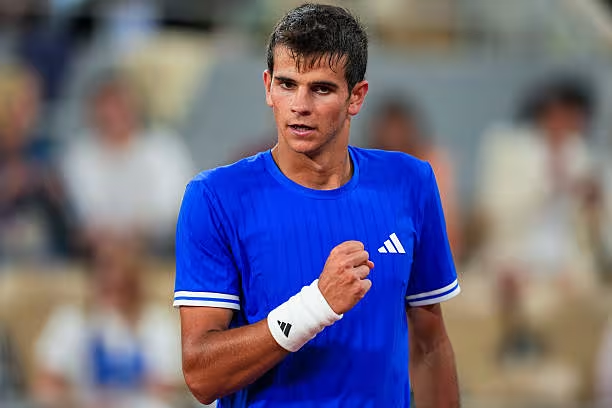
However, caution is needed. Many months without playing on grass, a surface that demands different mobility and support. Initially, there are aspects of Jódar's game that should transition smoothly to grass: he bends his legs well to play low shots on his backhand side, his returns can be devastating, he plays well at waist level or lower, and his offensive intent and long limbs should allow him to dominate points even more frequently. However, his forehand might be pressured by players with a very flat game: it's the shot with the most spin, giving him room to accelerate the ball’s revolutions, with a trajectory more typical of clay courts or hard courts.
It is too early to expect great performances from Jódar, yet, on grass. All promising players needed a certain adaptation period and faced defeats against more experienced players on this surface, so it's normal that Rafa will need time to get going... but in the future, it should be a real concern, especially if he adds the slice backhand to his technical repertoire. Moderate enthusiasm would be a good diagnosis: a good tournament in Eastbourne or Queen's, the perfect catalysts for Wimbledon.
What are Landaluce's options on the grass court tour?
Few young players can boast a positive record on a surface they have little adaptation to. Martín Landaluce is one of them, and this week he has already shown why. His performance in Stuttgart, including a victory over a specialist like Herbert and taking a set off and pushing Taylor Fritz to the limit, is a clear example of his immediate impact on a surface that allows him to achieve significant wins.
Like Rafa, the Madrid native's journey on grass in the junior circuit was absolutely groundbreaking. Two titles in junior tournaments prior to Wimbledon, including victories over Michelsen and Fonseca, and semifinals at the Tennis Cathedral, defeating Learner Tien along the way. His team always had a good eye: they knew Landaluce's potential on grass could be limitless, and last year they chose to properly prepare him by competing in a couple of Challengers before playing the qualifying rounds at Wimbledon.
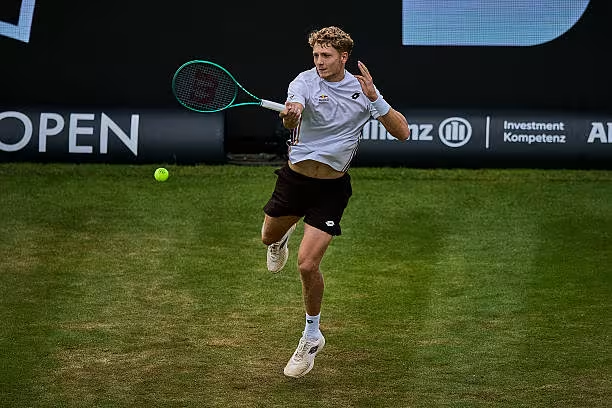
He reached semifinals in one of them and showed that he was ready to win once his game and mentality matured. Now, with a more composed and courageous Landaluce in key moments, the breakthrough in terms of rankings has come... and grass seems to be the perfect catapult for him. Strong leverage to enter with the inverted forehand, very solid backhand, much flatter tennis (his ball bounces lower) than, for example, Jódar himself, a serve that benefits from the speed of the surface, perfect length and reach and the ability to switch quickly with parallel shots. His type of play could wreak havoc on this surface, he has more experience than other young players, and he arrives at the peak of his sports career.
In principle, the recipe indicates success all the way. Still waiting to potentially secure a spot in Halle due to a withdrawal, if the draw is kind to him at Wimbledon, we could even dream of advancing to the second week of a Grand Slam tournament once again with the Madrid player. His style of play has the perfect mix to go far on this surface throughout his career... and this could be the perfect year to start proving it. Shall we get excited?
This is an automatic translation. You can read the original news, Jódar y Landaluce, ¿realidad o ilusión en hierba?