

Selekhmeteva: "When they confirmed to me that I was Spanish, I cried with joy and emotion"
The recently nationalized Spanish player explains at Roland Garros 2026 the process and why she has decided to stop representing Russia.

Oksana Selekhmeteva experienced one of the most special and emotional moments of her entire sports career at Roland Garros 2026. Beyond the defeat, the Russian-born player played an official match representing Spain for the first time, a change of nationality that had been brewing for years and, as she emotionally acknowledged, ended up bringing tears of joy when she received the official confirmation.
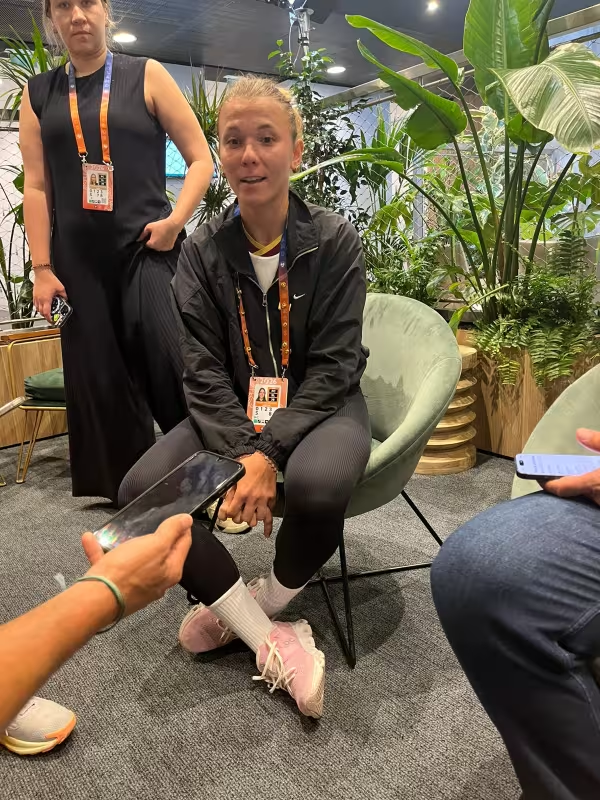
In a conversation with Spanish media after her match in Paris, Oksana Selekhmeteva openly spoke about her deep connection with Barcelona and Spain, explaining the sporting and personal reasons that led her to stop representing Russia. She also candidly shared about the economic and professional difficulties she currently faces while trying to establish herself definitively on the circuit. The tennis player made it clear that, while she retains part of her roots, she now feels that her true home is in Spain.
Her Emotional Bond with Barcelona and Spain
"I first went to Barcelona when I was 14 for a couple of months and then returned again. I have been living there since I was 15, training there, and truly have my whole life there. It's hard to explain because, in the end, we travel forty weeks a year, but when I go back, my parents are there, my dog Leo is there, and my whole life is there. The truth is, for me, it is an honor to represent Spain."
Reasons for Stopping Representing Russia
"It wasn't a political decision. The reality is that in Russia, it's very hard to train to become a professional tennis player. It's extremely cold, and logistically, everything is very complicated. I had to train tennis in one place and then spend two hours in traffic just to do my physical training. It was very difficult to build a proper structure."
"I genuinely believe that Spain is the best country in the world to have the necessary structure to develop as a professional tennis player, and that's why we made this decision."
The Challenges of Completing the Change of Nationality
"It has been a very long process. It began in 2023 and practically took three whole years. The last year was particularly complicated due to all the issues related to documents and visas. There were truly difficult moments."
"When I first saw a small post on Instagram saying that I was already Spanish, I didn't even know if it was true. Then Javier Soler wrote to me to confirm it officially. I still don't have the passport, but as soon as I return to Barcelona, I will complete all the paperwork. I started to cry because I felt very happy. It was a very long and not easy journey."
The Struggle of Moving Forward Without Sponsors
"Right now, I don't have sponsors, and honestly, that makes everything much more difficult. In tennis, you need to constantly invest a lot of money to travel, pay coaches, hotels, and all the structure this sport requires."
"Many times people only see the big tournaments and think everything is easy, but the reality for many players is completely different. Fortunately, I have my family helping me a lot and also close people who believe in me because without that, it would have been practically impossible to move forward."
Current Relationship with Russia
"I was born there, and part of my family still lives there. My sister is still there. But at the same time, I now feel that my home has been Barcelona for a very long time. It's hard to explain exactly how I feel because there are many mixed emotions."
Her Affection for Spain
"I love the people and the mentality they have here. In Spain, you know how to enjoy life much more, and I believe that also helps a lot in tennis."
"In Russia, there is much more of a mentality to work 24 hours a day constantly. Here, there is also a lot of work, but you understand that there is also time to rest, to live, and to enjoy. I think little by little, I am becoming more Spanish, although I still feel like I am a mix of both cultures."
The Russian Mentality She Retains on the Court
"I still think I have that Russian part of being a warrior and always going all out when I want something. In Russia, we are very much like that, very persistent and mentally strong when we have a goal."
Her Tennis Role Models and Playing Style
"I think my style has a bit of Rafa Nadal, especially because I am left-handed and have that intensity. I also admire Maria Sharapova's mentality a lot. I try to be aggressive but also vary rhythms because currently, tennis is extremely fast, and you have to adapt."
Despite the defeat at Roland Garros 2026, Oksana Selekhmeteva lived one of the most important and emotional chapters of her career in Paris. The player made it clear that Spain is already an essential part of her personal and professional identity and that representing the country means much more to her than a simple administrative change within the circuit.
This is an automatic translation. You can read the original news, Selekhmeteva: "Cuando me confirmaron que era española lloré de alegría y emoción"