

Parry explains his decision to "partially" abandon the one-handed backhand
The young French tennis player has made a substantial change, opting for a two-handed backhand and alternating between hitting with one or two hands in an organized chaos during the point.

Diane Parry was one of the few elite players who maintained a one-handed backhand, but watching one of her matches in recent months can generate strong confusion in the mind of any fan. The Frenchwoman decided to start using a two-handed backhand on the return, showing a tendency to improvise during the rest of the point. She explained this in the press conference prior to Roland Garros 2026.
But what has happened to Diane Parry's one-handed backhand? This is what I thought when I saw a video on social media weeks ago of the French player returning a serve with a two-handed backhand. One of the last strongholds of the one-handed backhand on the WTA tour, the only one before the professional emergence of Tagger, had vanished in that sequence.
This week, I was able to watch one of her matches in Strasbourg, and my unease turned into astonishment and incomprehension as I saw that, during the points, she still occasionally hit a one-handed backhand, although she relied heavily on sliced shots and, very sporadically, also used a two-handed backhand. Such a disruptive decision in a 23-year-old tennis player could only be a response to a sense of urgency that she herself has taken the time to explain in Roland Garros 2026, although it seems like there is much work to be done in this complex process.
This is how Diane Parry explains her decision to gradually eliminate the one-handed backhand from her game
The decision to incorporate the two-handed backhand
"The preseason is practically the only time of the year when you really have time to work on significant changes, and with my team, we felt that there were aspects of my game that needed improvement. We thought that the two-handed backhand could help me, especially on the return."
"The main goal was clearly the return. I always used a lot of slice on returns because I didn't have enough time to change my grip and set up to hit the one-handed backhand. It was a part of my game that I was not satisfied with because I couldn't take control of points as I wanted. I felt like I needed another solution."
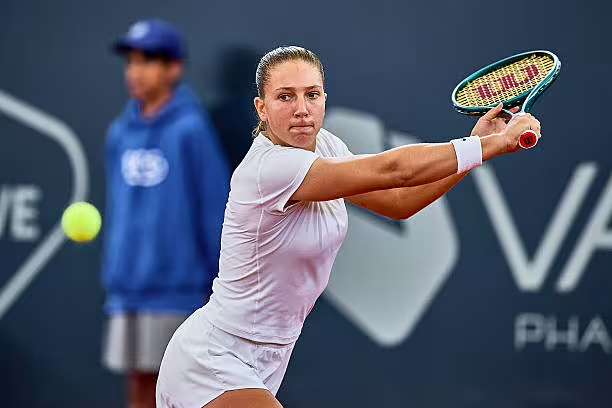
The differences between returning with one hand and with two hands
"With the one-handed backhand, you have less strength on the return, and this is very noticeable against players with strong serves. With the two-handed backhand, I feel like I can at least block the ball better, return faster, and take the initiative earlier in the point. I think that can help my game a lot. Right now, I feel much more comfortable than I did a few weeks or a month ago. It still needs to keep improving, but I think it's clearly heading in the right direction."
Remembering when she switched from two-handed to one-handed backhand
"When I was young, I played with a two-handed backhand and switched to a one-handed backhand when I was about twelve years old. At that time, I had to start completely from scratch. I completely forgot my previous backhand, and in the beginning, I couldn't even keep a ball in the court. I had to relearn the entire stroke little by little. Now it's different because I'm not really changing my whole backhand; it's only specific situations."
The coexistence of both strokes during matches
"There are moments during matches where you simply react without thinking too much. You don't have time to consciously decide which shot you are going to use. Against Emma Raducanu, for example, there was a ball where I felt that the two-handed backhand was clearly the safest option, and it just came out that way."
Diane Parry is using a two-handed backhand on return now (but keeping one-handed in rallies)
— Owen (@kostekcanu) February 5, 2026
Noticed it during practice at AO but I wasn't sure if she was just messing around. Looks like she's doing it in matches though pic.twitter.com/Att56W4pEo
"Sometimes you are not in the perfect position to hit the one-handed backhand well, and in those situations, having the second hand assisting can greatly facilitate the stroke. I don't have a specific rule to decide when to use one or the other; it simply depends on the feelings and how the ball arrives at that moment."
Pure inspiration. That's how Diane Parry bases the rhythm of a technically significant change in her tennis, carried out after a profound analysis of how a stroke so beautiful and captivating for tennis romantics can be a drawback in today's game. It will be important to closely follow the evolution of the French player after this curious decision.
This is an automatic translation. You can read the original news, Parry explica su decisión de abandonar "parcialmente" el revés a una mano