

The main candidates to become new champions of Masters 1000 in 2026
In the current top-10 of the ATP rankings, there are up to 4 players who have never won a title of this magnitude. They will seek their chance at Indian Wells.

The men's circuit has been clearly dominated in recent years. Jannik Sinner and Carlos Alcaraz have turned the Masters 1000 into familiar territory. Their consistency, ability to perform on different surfaces, and mental strength have drastically reduced the element of surprise on the big stages.
However, when either of the two is absent or slightly drops their level, the scenario changes completely. The field of candidates expands, showing how closely matched the circuit is behind them. Last year was the best proof: Jack Draper, Jakub Mensik, and Casper Ruud claimed their first Masters 1000 titles. In 2026, the question arises again: Who could be next?
The Top-10 knocking on the door
In the current top 10, Lorenzo Musetti is perhaps the most talented player in the group. His one-handed backhand and creativity shine particularly on clay courts. The Italian reached the final of Monte Carlo 2025, where he fell to Carlos Alcaraz, confirming that under those conditions, his natural talent and versatility make him a clear contender in tournaments like Monte Carlo, Madrid, or Rome. Alex de Miñaur embodies consistency. He thrives on hard courts, especially in fast conditions where his speed and defensive skills turn into offensive weapons. He has come close in several Masters 1000 events, was a finalist in Canada 2023, and is a regular presence in later rounds, so his stability could lead him back to the final weekend.
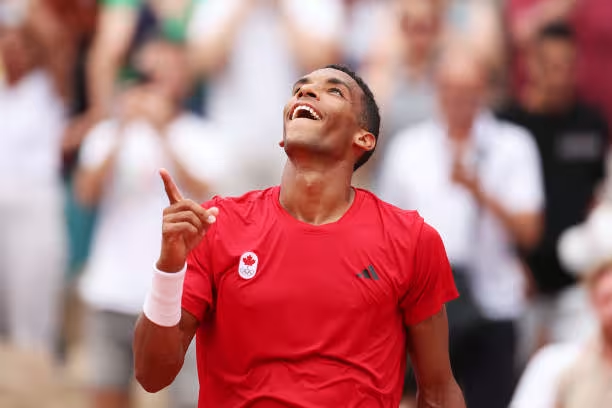
Canadian Felix Auger-Aliassime has also been near victory on more than one occasion. He lost the Madrid 2024 final to Andrey Rublev and once again fell short in Paris 2025, where Sinner halted his attempt. Two different scenarios — clay at altitude and indoor hard court — demonstrate that his competitive peak exists in different conditions. When his serve is on and his forehand finds consistency, he can aim for the top. With mental stability, he is a genuine contender. The same applies to the last Top-10 player without a Masters 1000 title. Alexander Bublik is the unpredictable factor. Capable of defeating anyone in an inspired week, especially on fast surfaces, his challenge lies in maintaining concentration over seven consecutive matches.
Those who can have a “magical week”
If Mensik and Draper demonstrated anything last year, it is that in a Masters 1000, it is not always the most consistent player throughout the season who wins but rather the one who strings together one or two weeks of absolute inspiration. Here emerges a broad, dangerous, and increasingly prepared group.
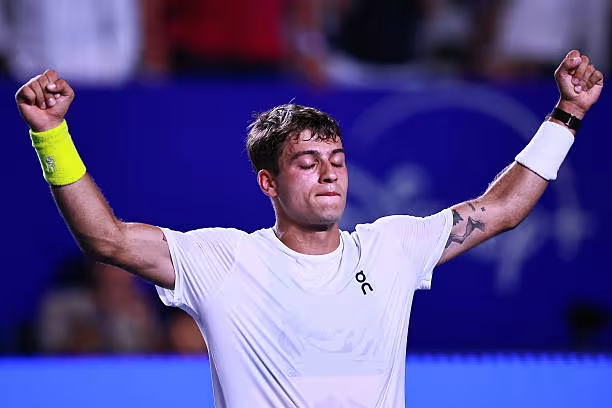
Youthful talents like Arthur Fils, Flavio Cobolli, recent winner in Acapulco, or Francisco Cerúndolo have shown they can compete head-to-head with the best in major tournaments and that, in a week of inspiration, they can string together victories at the highest level. Others with more experience such as Tommy Paul, Frances Tiafoe, who already reached a final in Cincinnati, or Jiri Lehecka also have enough arguments to stage a breakthrough of this nature.
The new generation emerges
Joao Fonseca and Learner Tien symbolize the generational shift. Fonseca, with an explosive forehand and a fully offensive game, seems destined for great things, although it may still be too early to demand a title at this level from him. Tien, more structured and tactical, could surprise sooner than expected if he finds the right context.
This is an automatic translation. You can read the original news, Los principales candidatos a convertirse en nuevos campeones de Masters 1000 en 2026