

Tsitsipas and his goal for the Australian Open: "I just want to go out on the court, compete, and enjoy the competition"
The Greek is getting ready for the first Grand Slam of the season and asks for a 2026 "in which I can push myself to the maximum without doubts about whether I will be able to perform or not."

Stefanos Tsitsipas resets the counter. The Greek player wants to move on from the tumultuous and inconsistent 2025, marked by his back injury, poor results, and off-court instability. Therefore, for 2026, his priority is to be in good physical condition and, above all, to enjoy playing again.
This was stated during his Media Day at the Australian Open, the place where he reached the final in 2023 against Novak Djokovic, a tournament where a renewed aura arrives, but also accompanied by a much more mature perspective on his body, mind, and the demanding circuit schedule.
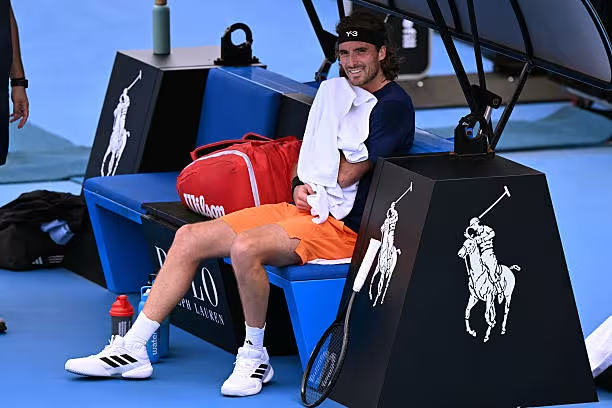
Stefanos Tsitsipas approaches the 2026 Australian Open with renewed energy
"Each year brings different ideas. Each year brings different goals and aspirations. I think it's a great opportunity to test myself. Hopefully, it will be a healthy 2026, where I can push myself to the maximum without doubts about my performance and without the uncertainty of whether I can string matches together."
No longer worried about his physical condition
"I am very grateful to all the doctors who have done an incredible job to get me back on the court, and to my team, who have been consistent and believed in the process. I want to thank all those people who have allowed me to regain my original form in recent months."
"I am enjoying tennis. When I find myself in a condition like this, I enjoy tennis whether it goes well or not. At least I have feedback. I know what didn't work, and I can go to the next match knowing what to avoid and what to focus on more. When you're injured, you don't even have that information because you barely step onto the court to try to play a match. It's a whole different set of worries that hit you in that situation."
About his performance in Adelaide
"Feeling like myself and seeing that I am really progressing with my game gives me peace of mind. I know Adelaide wasn't great last week, but I remain quite optimistic and feel good about my tennis. Such a defeat will not dent me or make me feel worse."
"It was a good opportunity to push myself a bit more, and it's positive to play matches like that because they provide me with information about my game and allow me to see myself competing week after week without worries or problems. That also helps me enjoy tennis more and approach the year ahead with enthusiasm."
Back problems affected him mentally
"It always affects. It is scientifically proven that spine injuries also affect the brain. You can investigate it. I have read a lot about it. Spine injuries are no joke. The back is one of the most sensitive areas of the body, and if affected, it can have a very strong mental impact."
"If your mind is not healthy, the body also suffers. And when you are not mentally well, the body starts to collapse. Especially when you are an athlete at this level, who needs to be consistent day after day, show up on the court fresh, and be willing to sacrifice many things to fulfill your dream. All that has a huge impact on your daily life. I reached a point where I didn't even prioritize results. They did not matter to me. The only important thing was to train well, not feel pain, and not be limited by anything. I knew that results were not going to come because when you are in that mental state, winning tournaments is the least important. You are barely trying to stay afloat."
His goals for the Australian Open
"I want to feel competitive every time I step on the court, capable of competing against any player. That is my main goal. I am not looking for extraordinary things. I just want to get on the court, compete, and enjoy the competition, that constant exchange between players, and fall in love with that process. I want to immerse myself in that spirit and see what it awakens in my game. That is what I am focusing on right now."
Criticism of the calendar
"My body is a fortress and is the most important thing in the world. If I don't have a healthy body and mind, everything else becomes secondary. My best results came when my body and mind were aligned and healthy. That's when I enjoyed tennis the most. There are serious concerns on the circuit. I don't like to complain because I love the ATP circuit and the opportunities it offers us, but the calendar is too saturated."
"I don't think it's a coincidence that so many players got injured in 2025. I saw a statistic about the number of retirements, and it seems like a direct consequence of how the calendar is structured. The Masters 1000 events are too extended. Small adjustments could find a perfect formula."
Prioritizing his health before playing too many tournaments
"I don't want to reach a point of burnout. There are sponsors and many people behind me who want to see me compete and healthy, just like me. If something prevents me from competing, I will prioritize it, even if there are consequences. But the circuit could be more collaborative with the players."
"It's not about drastically reducing everything, but making it more appealing. Twelve days for a Masters 1000 is excessive. Ten days would be ideal. When tournaments turn into marathons, people lose focus. Bercy or Monte Carlo are great examples. Short, intense tournaments with good matches and great following. There is a formula to do it right. We just have to make sure that players are part of the system and do not feel excluded. We want this to work," concludes a Stefanos Tsitsipas ready to fight again, as long as his body cooperates.
This is an automatic translation. You can read the original news, Tsitsipas y su objetivo para el Open de Australia: "Solo quiero salir a la pista, competir y disfrutar de la competición"