

Ruud, on the Alcaraz and Sinner generation: "They have made me realize that I have to change my tennis"
Brave words from the Norwegian when talking about tennis players like Sinner or Fonseca, confessing that he constantly studies them and that they have made him change aspects of his game.

There are few tennis players who show as much sincerity in front of the microphones as Casper Ruud does. Norwegian rarely shows problems in unraveling tactical matters or revealing his feelings about certain topics, making him one of the players most appreciated for questioning. The Oslo native embarks on a new campaign with several novelties: impending fatherhood, recent marriage, and the constant pursuit of progress to narrow the gap with the best.
Those best, of course, could be summed up in the two names that rule the ATP circuit with an iron fist. However, Jannik Sinner and Carlos Alcaraz should not be treated in isolation: starting from the Italian, perhaps the greatest ambassador of the type of tennis he practices, they have created a style of play that he himself admits he had not seen before since entering the elite. From Jannik to Joao Fonseca, the other name mentioned, Ruud acknowledges 21st-century tennis... has, at times, outflanked him.
He did so in the lead-up to his debut at the ATP Auckland 2026, having arrived there after several warm-up matches in the United Cup. Reflecting on one of his losses in Sydney, he spoke to exemplify another player who belongs to this ensemble, but his eloquent speech began by pinpointing where this kind of "new tennis" originates. "This new generation ranges from Sinner, perhaps the 'senior' one, to Fonseca, the youngest of all. Those players, compressed within a space of five or six years, have a playing style where they truly unstitch the ball. They play a different style of tennis, a style that I have had to get used to over time," Casper notes before taking the scalpel and, by the way, making a sincere confession.
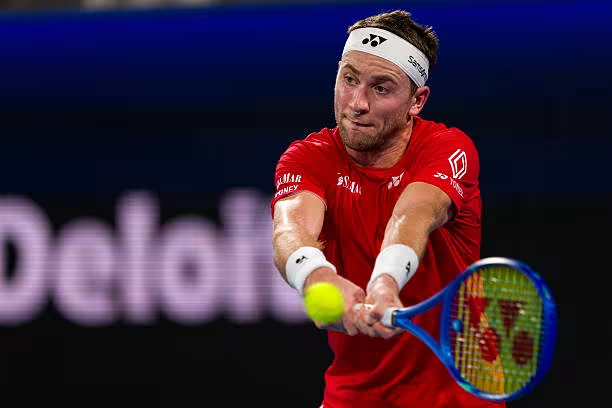
Ruud defines the strengths of names like Sinner or Alcaraz and points out the sacrifices he has had to make on the circuit to adapt to them
Sinner and Alcaraz push to the limit a way of imposing and dictating the rhythm that has raised the intensity of this sport, perhaps to historic highs. If we add the current state of the balls, heavier than ever, Casper has no problem admitting that this new trend has caused him problems and uncertainty. "They not only have a great weapon; it is usual for them to have two clearly defined weapons, that both the forehand and the backhand are fantastic.
If you look at last week, I lost to Jakub Mensik in the United Cup. He has a fantastic serve, but also a magnificent backhand, and he strikes well from both sides. This is something you see more and more often, and observing how this sport has changed has made me realize that I also need to change my game a bit. I have studied many of these young players in recent months to see how I can develop my tennis, with the aim of being able to contain the style they bring to the table."
A sincere and realistic confession from a guy who has firsthand experienced the frustration of facing unstoppable versions of Jannik or Carlos: he was a victim of the Italian's best statistical performance in 2025 (quarterfinals in Rome) and the most offensive and courageous Carlos Alcaraz of the entire season (in Tokyo). Will we see a renewed Casper, relying heavily on his backhand to equalize that balance from both sides? Is he capable of putting into practice those theoretical notes he has been gathering? 2026 will undoubtedly be a good test to find out.
This is an automatic translation. You can read the original news, Ruud, sobre la generación de Alcaraz y Sinner: "Me han hecho darme cuenta de que tengo que cambiar mi tenis"