|
2 Sep 2025 | 13.39
|
2 Sep 2025 | 13.39






Moments before stepping onto the court last night, Alexander Bublik remarked about Jannik Sinner saying he looks like a player created by artificial intelligence. The Italian's triple 6-1 victory reaffirmed his belief that Sinner is not human. The world number 1 later revealed, at the end of the match, the trick he employed to completely outplay the Kazakh with his serve.
Bublik had not faced a single break in the 59 times he served at this US Open until this match. Sinner wasted no time, breaking his serve within two minutes. The Italian managed to break Bublik's serve eight times throughout the game, winning 57% of return points. Effectively, Sinner earned more points on return than Bublik did on his own serve. It was a flawless tactic, but what exactly did the world number 1 do to achieve this?
In elite tennis, every tiny detail matters. Though imperceptible to the general public, minor technical adjustments in foot positioning, elbow, shoulders, or hands can make a significant difference. When studying opponents, tennis players utilize their own methods to gain an edge. This is why players like Sinner excel - they dedicate their free time to analyzing opponents and exploiting weaknesses, just as he did to Bublik last night.
Speaking with ESPN, Jannik revealed the "trick" he used to neutralize one of the best serves on the circuit and demonstrate mastery. The Italian studied Bublik's serve mechanics, noticing subtle differences in shoulder position right before serving and where the ball was placed to prepare for the serve.
In essence, Sinner discovered that by observing how the ball was thrown for the serve or the shoulder position moments before contact, he could predict where Bublik would aim his serve or what type of serve he would execute. This may explain how the Italian managed to return incredible shots on 220km/h serves. Bublik wasn't far off in comparing Sinner to artificial intelligence.
Sinner on the ESPN desk says watching minute differences in the server’s shoulder position as well as the toss location enable him to quickly make a calculated prediction of where the serve will land.
— Amy Lundy Dahl (@AmyLundyDahl) September 2, 2025
He really is AI.
This method is reminiscent of the tactic used by Andre Agassi to predict Boris Becker's serve. Agassi mentioned in his book how the German player would stick his tongue out before serving, using its edge to indicate the serve's direction. At the highest level, every detail like this matters.
Revealing the serve placement through ball toss or shoulder positioning is an area Bublik needs to address to prevent similar defeats from other rivals as he experienced against Sinner. Players with distinctive mechanics are at a disadvantage against opponents. The best serve in tennis isn't the fastest but the most challenging to anticipate.
To achieve this, it's best to keep the ball toss low and utilize a rapid, electric motion. This way, the returner has minimal time to read and predict the serve's direction. Players like Shelton, as an example, hold this advantage as their serve is hard to read due to its quick execution. Another player with a similar serve was Federer, whose serve was particularly damaging because it was nearly impossible to predict.

In recent times, Nick Kyrgios stood out in terms of serving. Here at Punto de Break, we analyzed his serve because he had a distinct trait of tossing and performing the same serve motion for wide and T serves, making it nearly impossible to predict. When coupled with a 220 km/h serve, it became the most lethal serve on the circuit.
Sinner's divulged technique can offer viewers insight into the meticulous preparation that sets players apart. Beyond playing style or strategies, meticulous scrutiny of details like shoulder placement before serving is crucial for winning matches. While he may not be AI-generated, Jannik Sinner leaves nothing to chance in his quest to be the world's best.
This news is an automatic translation. You can read the original news, Sinner desvela el "truco" que usó para reventar el servicio de Bublik
-
 15 Jun 2026 | 08:00Alcaraz's recovery enters a crucial moment
 -
 15 Jun 2026 | 18:00Alcaraz aims for three possible tournaments for his return
 -
 15 Jun 2026 | 20:00Davidovich reveals how he prepares for the grass court tour
 -
 15 Jun 2026 | 13:00Mensik explains what is the hardest thing about playing on grass for him
 -
 15 Jun 2026 | 21:00The serious risk Djokovic faces at Wimbledon
 -
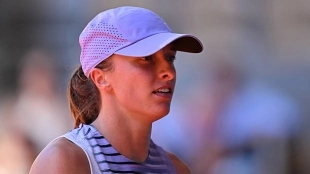 16 Jun 2026 | 07:00Swiatek talks about Chwalinska's feat at Roland Garros: "It changed her life"
 -
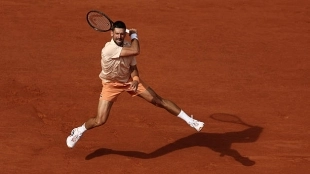 15 Jun 2026 | 00:00ATP Ranking: Djokovic's Presence in the Top 10 in Danger Eight Years Later
 -
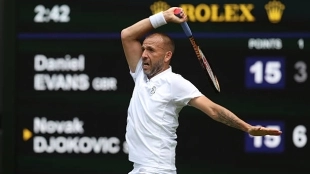 15 Jun 2026 | 23:00Daniel Evans' dart at the Queen's tournament after not receiving a wildcard
 -
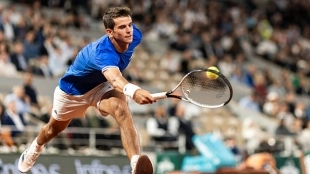 15 Jun 2026 | 17:00BREAKING: Jodar withdraws from Queen's due to injury
 -
 16 Jun 2026 | 10:00The worrying consequences of Jódar's injury ahead of Wimbledon