

Can Rafa Jódar win against Jannik Sinner in the Madrid Open quarterfinals?
Special match for the Madrid native, who will face the world number one in his home, at the Caja Mágica. Is there a path to victory for the great sensation of the circuit?

The day of baptism by fire has arrived for Rafael Jódar. Few experiences offer more lessons than your first time facing a world number one, a lesson learned by all the greats of this sport when they encountered a different beast. However, his first encounter with the ranking king is surrounded by special circumstances: it will take place at the Mutua Madrid Open 2026, the natural habitat of a Madrid native who will have all his fans to overthrow Jannik Sinner.
He is the final monster, a challenge that has little to do with the previous ones. The merit of Rafa Jódar's Madrid adventure is undeniable: imagine being able to defeat Jesper de Jong and Vit Kopriva as the heavy favorite when you have only been a professional for five months, imagine dominating Alex de Miñaur to achieve your first triumph against a top-10 player, and imagine winning the battle for leadership of your generation, in prime time, against Joao Fonseca. All have been tests of galactic proportion; however, Sinner is a different story.
The circumstances surrounding the Italian's journey in Madrid, with certain reservations regarding his physical condition and a first match where he too endured suffering (struggling through peculiar Madrid conditions, he dropped a set against Bonzi), do not matter. Neither does the fact that this is the only Masters 1000 tournament where he has not gone beyond the quarterfinals, a record that only lacks one obstacle to shatter: Rafael Jódar Camacho.
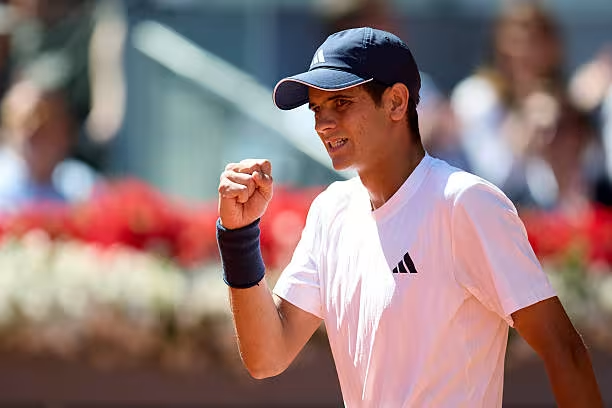
Can Jódar beat Sinner in the Madrid Open? We analyze the keys that could lead him to victory
If there is one aspect of Jódar that has impressed the tennis world this week, it is undoubtedly his mental strength and composure. His courage and bravery under pressure, played exceptionally well. The feeling that, despite his low mileage, Rafa already belongs to the elite, devoid of any kind of pressure, as if he were in his backyard. Viewed in this way, the first major obstacle when facing someone like Jannik, the pressure of matching up against the circuit king, should not be, initially, a formidable barrier.
On the tennis front, the doubts increase somewhat. Why? Because Jódar has not yet faced a player on the circuit who plays with the speed, power, and precision of Sinner: he has been able to overwhelm even top-10 players... but the Italian offers a very different ball rhythm, one that typically prevents his opponents from taking the initiative, making them step back and end up being subdued by the San Candido native.
This directly clashes, of course, with the tennis that Rafa has been displaying and with his DNA as a player. The Madrid native has reduced all his opponents to nothing from the baseline, forcing them with lightning-quick returns and significant changes of direction to play more than two meters behind the baseline. Need proof? All his opponents in Madrid, from de Jong to Kopriva, have exceeded their average hits from over two meters behind the baseline, positioned much farther back on the court than they would like.
Rafa suffocates his opponents and will have to be even more clinical than ever to suffocate Sinner, against whom there are very few shortcuts: you either become a kamikaze with phenomenal accuracy (like Novak Djokovic burning his forehand in Australia)... or you complicate things through variety, changes in height, setting up a full-court game, as Dimitrov did at Wimbledon or as Alcaraz has often done on clay.
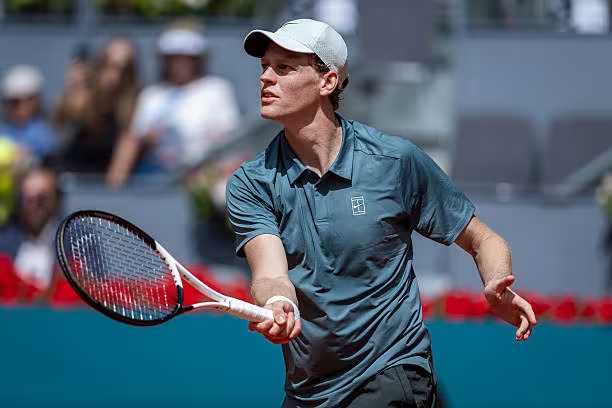
Considering Jódar's style of play, the only option left is to bet on step one and do so by doubling down: returns at the feet, seizing every second serve offered by Sinner; immediately redirecting with his parallel backhand, even if he feels he is playing at a faster pace (and therefore, higher risk) than he has throughout the tournament; daring to come to the net occasionally, shrinking the spaces, and making Jannik feel small. The percentage of first serves by the Italian will be crucial; if he maintains a strong serve, Rafa's chances to dominate from the return diminish, forcing him not to shrink from service and relying entirely on dominating the pressure points.
Perhaps a good example to follow is the match that Joao Fonseca presented to the Italian at Indian Wells. He did not win a set, but he came close to winning both... and always succeeded when he left the diagonal exchanges from the backhand area, both with the inverted forehand and with the parallel backhand, moving to the attack and equalizing the time spent by both in the offensive. Jódar, who plays 30% of his shots offensively, also needs this statistic to be in his favor; if Sinner equals or surpasses him, it would thwart the Madrid player's plan.
In summary, Rafa must be more precise and accurate than ever in his attacks... and impose even more if possible. If the unforced error count rises? It doesn't matter. If the points are too short and the match loses its brilliance? It's okay. Sinner can only be beaten by going after him, not shying away from the battle... and if there's one thing Rafa doesn't lack, it's authority, courage, and bravery. Tomorrow, at 4:00 p.m. Spanish time, get ready for a high-level duel, the baptism of fire of a humble boy from Leganés who wants to conquer the world of tennis. Don't miss it.
This is an automatic translation. You can read the original news, ¿Puede Rafa Jódar ganar a Jannik Sinner en los cuartos del Madrid Open?