


 |
24 Apr 2025 | 09.30
|
24 Apr 2025 | 09.30





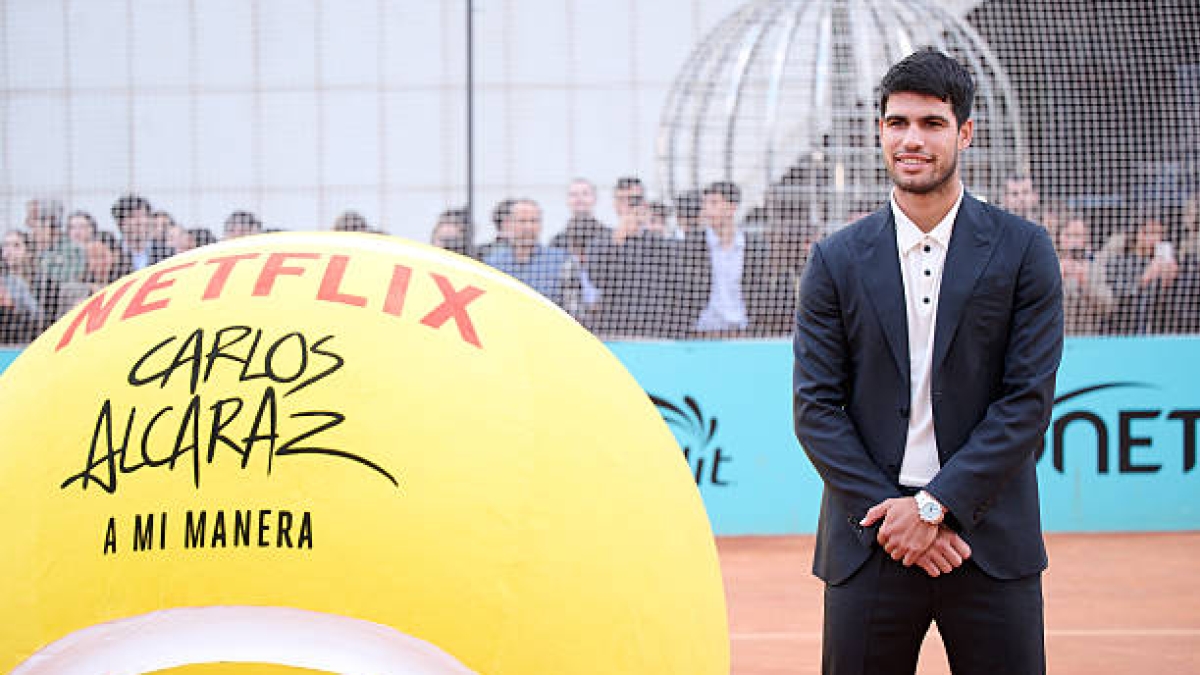


Finally, after several months of promotion and a last few weeks where several advances were revealed, you can now see on Netflix the documentary ‘Carlos Alcaraz: My Way’. In this production, the platform's cameras accompanied the Spanish tennis player throughout 2024, having access to unseen images and moments of the Murcian's season. Both the good and the bad appear without any filter in a documentary that, far from idealizing the figure of Alcaraz, emphasizes the difficulty and sacrifice of wanting to be the greatest player of all time while needing to enjoy the life of a 21-year-old.
And it is around this great dilemma that the three chapters of the miniseries revolve, where we see an Alcaraz so close and natural that he speaks with a Murcian accent. Additionally, the importance of his team is shown, formed by his coach, Juan Carlos Ferrero, his manager, Albert Molina, his two physiotherapists, Juanjo Moreno and Alberto Lledó, and his older brother, Álvaro Alcaraz.
His team, the other great protagonist of the documentary
Throughout the three chapters, the bond they all have is shown, as well as the sacrifice his entire team makes to support him. However, from the very beginning, there are reservations from part of his inner circle about the various vacations the tennis player enjoys. Above all, Ferrero is the most critical, even doubting whether his player will be able to be the best in history if he does not accept sacrifices that he is not currently making.
But emphasis is also placed on the 21 years that El Palmar's native has and on how quickly fame came to him when he won the US Open in 2022 and became the youngest number one in history at 19. In fact, Alcaraz confirms in the documentary that he hates the word 'obligation' and that he cannot bring out his best tennis when he is not happy and relaxed.
His family and his people, essential
Other key figures in the miniseries are his parents, his friends, and his home in El Palmar. In fact, the recording begins in his lifelong room with all his trophies, followed by a family meal on his house's terrace. At another moment, he gathers with all his friends to celebrate his 21st birthday. There, he emphasizes again that he needs his people to disconnect from the demands of the circuit.
Following the scenes at his home and with his family, the first chapter focuses on the clay court tour and shows a pivotal moment of the Spaniard's season: his forearm injury. It is striking to see how the cameras capture the moment when he tearfully accepts that he will not be able to play in the Conde de Godó. Also, his participation in the Mutua Madrid Open, where he mentally blocks due to pain in his right arm, is depicted.
Moreover, among the various scenes showing the Spaniard's season, statements from great figures in the tennis world such as Rafa Nadal, Roger Federer, Garbiñe Muguruza, Martina Navratilova, Björn Borg, and John McEnroe are included.
From glory in Paris to reproach for his vacations in Ibiza
The first chapter ends with his victory at Roland Garros, his ability to face cramps, and his rivalry with Jannik Sinner. It also shows his celebration in Paris. The second chapter begins with his vacation in Ibiza and the team's reproach for the conditions in which he arrives at the Queen's tournament. Here, the most intense moment by his team members occurs, opening up to explain the sacrifices and dedication they have to make for Alcaraz to become one of the greatest.
Throughout the documentary, Ferrero provides a counterpoint to the tennis player's viewpoint, insisting on wanting to make his own decisions and not having them made for him, acknowledging that he can make mistakes. It is a constant struggle between what he needs and what he must do, balancing his professional and personal life.
'Nadalcaraz', Djokovic, and the Olympic Games
Rafa Nadal's example emerges here, showing his complete dedication to tennis, but Alcaraz does not want constant comparisons with the Mallorcan, nor does he believe he is ready to sacrifice everything. Nadal starts to feature in the documentary with the arrival of the Olympic Games, reflecting the good relationship between them but also the extra pressure Alcaraz faces, which culminates in his defeat in the individual final against Novak Djokovic, leaving him in tears.
From this point on, the most challenging and profound part of the documentary unfolds, coinciding with the mental and tennis slump of the Murcian in Cincinnati and the US Open. Indeed, Alcaraz gets emotional recalling the tough times he went through in those two months, admitting that he lost his tennis enthusiasm.
Different perspectives, same goal
The final minutes of the documentary showcase the Laver Cup in Berlin, his reunion with Roger Federer, and Nadal's goodbye at the Davis Cup in Malaga. However, the peak moment is the final conversation with Ferrero, where their differing views on tennis resurface, but it is clear that they are united and strive for a common goal: to make Carlos Alcaraz the greatest player of all time.
Ultimately, for a Netflix sports documentary, it diverges significantly from the idealistic and unreal vision of other productions. It shows Carlos Alcaraz as he truly is, with his strengths and weaknesses. From the perspective of a 21-year-old who is yet to decide the path to fulfilling his goal of becoming the greatest. He knows what but not how. It also confirms the crucial role of his entire team and family, essential to fulfilling Alcaraz's other desire: to be happy above all.
This news is an automatic translation. You can read the original news, Review del documental de Alcaraz: El difícil equilibrio entre el sacrificio del tenista y la felicidad de un chaval










-
 29 Apr 2026 | 10:00Cobolli: "I am very proud to win against a legend like Medvedev"
 -
 30 Apr 2026 | 12:00These are the great challenges for Rafa Jódar in the rest of the clay court tour
 -
 29 Apr 2026 | 19:00Sinner praises Jódar: "He has everything one must have"
 -
 29 Apr 2026 | 13:00The 2005-2006 Generation, Called to Make History
 -
 30 Apr 2026 | 13:00The 5 key aspects of Rafa Jódar's tennis
 -
 30 Apr 2026 | 09:00Son, about his match with Sinner: "I know I will have opportunities"
 -
 30 Apr 2026 | 00:00Kostyuk explains why she will not shake hands with Potapova tomorrow
 -
 29 Apr 2026 | 21:00There are ATP 250 tournaments that would like to have the Faulconbridge Cup list
 -
 29 Apr 2026 | 18:00Sinner imposes his law and stops a determined Jódar


