

The 5 key aspects of Rafa Jódar's tennis
In this 2026, Rafa has thrilled everyone with his tennis. We break down the strengths that make him so unique and special.

Rafa Jódar is in vogue. Everyone wants to know more about this guy born in the neighborhood of Leganés who is captivating everyone with his powerful breakthrough in 2026, where he is already among the top 20 of the season in a career start rarely seen before. This raises curiosity to know what his main strengths are and what makes his tennis so special to achieve what he is doing.
It's not normal for someone to raise their level the way Rafa has in the last three months. If you watch one of his matches in Australia and then see him play in Madrid, it feels like 18 months have passed instead of just a quarter. His growth is both admirable and scary, valuing the giant steps he takes week by week or even match by match, and imagining where his ceiling could be with more time and experience.
The 5 aspects of Rafa Jódar's tennis that make him so special
To understand the distinctive features of Rafa's tennis, we must highlight several aspects that already place him in privileged positions. It's not normal, we repeat, to achieve this when it has been barely five months since he decided to turn professional and leave university. Here are the main current strengths of Jódar's tennis as of spring 2026.
Exceptional mindset: crucial moments
Undoubtedly, his best weapon. For a rookie, it's unusual to play crucial points the way Jódar does. In his first eight ATP tiebreaks, he has lost only two (against Fritz and Sinner) and won the other six. A sign that his mindset is extraordinary. Rafa doesn't flinch when the match gets tense. This is evident in the following data:
In the last year, Rafa is the second player on the circuit who converts the most break points. Yes, you read it correctly. Jódar ranks as the world's number 2 in converted break points, with 44.5% of them, just behind Machac's 45%, surpassing Alcaraz's 43.8% and Sinner's 43.5%, among other great returners. Amazing.
According to ATP statistics, Jódar stands as the eighth best circuit player in the last year in metrics measuring pressure points, indicating his progression and potential future placements.
Offensive tennis at its core: relentless pressure
From serve +1 to return +1, Jódar aims to keep attacking. He refuses to be dominated and strives to dictate the game at all times. We've always seen him do this against many of his opponents, but we wondered if he could maintain it against top players. In Madrid, he demolished the ball against De Miñaur or Fonseca, demonstrating not only his capability but also his mastery.
Rafa attacks 28.4% of the time when hitting a ball. That's nearly one out of three shots he plays. Against Fonseca, for example, he attacked 35% of the time. He aims to constantly apply pressure and suffocate his rivals. With just a few matches under his belt, Rafa is already the eighth player on the circuit in terms of attacking, surpassing even Sinner by 0.4% and Alcaraz by 3.1%. Impressive.
Rival's second serves: his favorite prey
In these first months of 2026, we have observed that there's a tactic Jódar frequently employs against all opponents, regardless of surface, which is to go all out on second serves.
Mostly standing in, he returns them with intense pressure, often leading to double faults by intimidating the server. Many times, he puts the second serve returns 36% of the way towards the baseline, which is 7% more than the circuit's average.
So far in 2026, Jódar has won over 52% of the second serve returns he has played, placing him seventh on the circuit:
1. Jannik Sinner 56.7%
2. Alex de Miñaur 54.1%
3. Fran Cerúndolo 53.5%
4. Novak Djokovic 53.2%
5. Carlos Alcaraz 53.1%
6. Daniil Medvedev 52.8%
7. Rafa Jódar 52.4%
Furthermore, his aggressive return game results in breaking his opponents 31% of the time. He stands as the circuit's second best player in return games won, trailing only Sinner's 32.3% and surpassing Alcaraz's 30.2%. This is indeed a remarkable feat in less than five months on the ATP circuit. His return wins exceed 40%, 5% more than the average.
Strong baseline play: seeking initiative
With his aggressive style of play, Rafa positions himself aggressively on the baseline, always aiming to take the initiative and strike first. While he still needs to face the world's best to successfully apply this tactic, he has executed it flawlessly until now.
Jódar wins nearly 54% of points played from the baseline. This places him as the circuit's 13th best player in points won from the baseline, sharing the same percentage as Sinner.
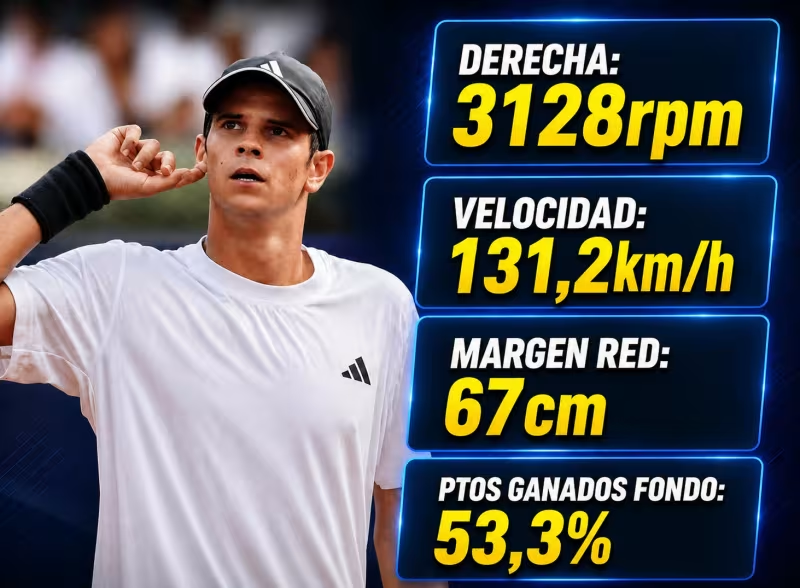
Despite having room for significant improvement in lateral mobility, Jódar covers a lot of ground due to his physical build, producing exceptional attacking tennis from both wings, as previously described. His opponents will have to strategize to push him back because, at 19, he generates immense power and, if in form, is challenging to deny the initiative. This is supported by his forehand that spins at an average of 3128 rpm with a speed of 131.2 km/h. Only Fils on the circuit produces more spin and power on his forehand than Jódar. While others hit harder on average, like Jarry or Medjedovic, they lack the spin Jódar applies. Additionally, he clears the net by only 67cm, with Sinner or Fils hitting at 63cm and Alcaraz at 72cm.
Consistent second serve
Another area where Rafa Jódar excels is with his service, particularly his second serve. He ranks fifth in the last year in points won with the second serve, at 56.2%, closely following Alcaraz and just 2.4 percentage points behind Sinner, the leader in this statistic.
Jódar's success here is not just about a strong second serve but also about his ability to set up a ball type that allows him to execute his game plan, hitting powerful forehands from the baseline while maintaining an offensive stance. The key to second serves is not losing track and continuing core baseline play. On the list, the top performers are all players with strong baseline games, providing a glimpse of what this young rising star can potentially become in the future.
This is an automatic translation. You can read the original news, Los 5 aspectos clave del tenis de Rafa Jódar