

What should competitive players look for in tennis shoes?
Do you train or compete regularly in tennis? You need to choose the right shoes so that you can focus solely on your game.

If you train and compete regularly, choosing tennis shoes is no longer a secondary issue. This article is designed precisely for that player who spends several hours a week on the court, frequently competes, and needs to know what to really expect from their footwear to perform when intensity increases.
Because you don’t just need comfortable shoes. You need shoes that fit how you play, how you move, and the demands you accumulate during training and matches. Fit, support, lateral stability, cushioning, traction, durability, weight, or responsiveness can have varying importance depending on each tennis player.
Before choosing your shoes, analyze how you play
ASICS starts precisely from that premise. The brand develops its shoes considering the different ways to move on the court and highlights three fundamental factors when choosing: our style and level of play, the surface on which we compete, and the fit we seek.
Think about your own matches.
Do you spend most of your time behind the baseline? Do you move constantly from side to side? Do you run many meters and continuously change position? Are you particularly explosive? Do your matches tend to be long? Do you alternate defense and attack depending on your opponent? The answers determine which characteristics should be more important to you.
If you move side to side, you need lateral stability
Lateral movement is one of the great peculiarities of tennis. If you are a baseline player and build many points by continuously moving from one side to the other, you need your shoes to provide support and stability when you stop and accelerate again.
In a demanding rally, you may move to one extreme, hit, regain position, and seconds later have to repeat the exact movement to the opposite side. It’s not just about reaching the ball: you need to feel secure when you plant your foot to execute the shot.
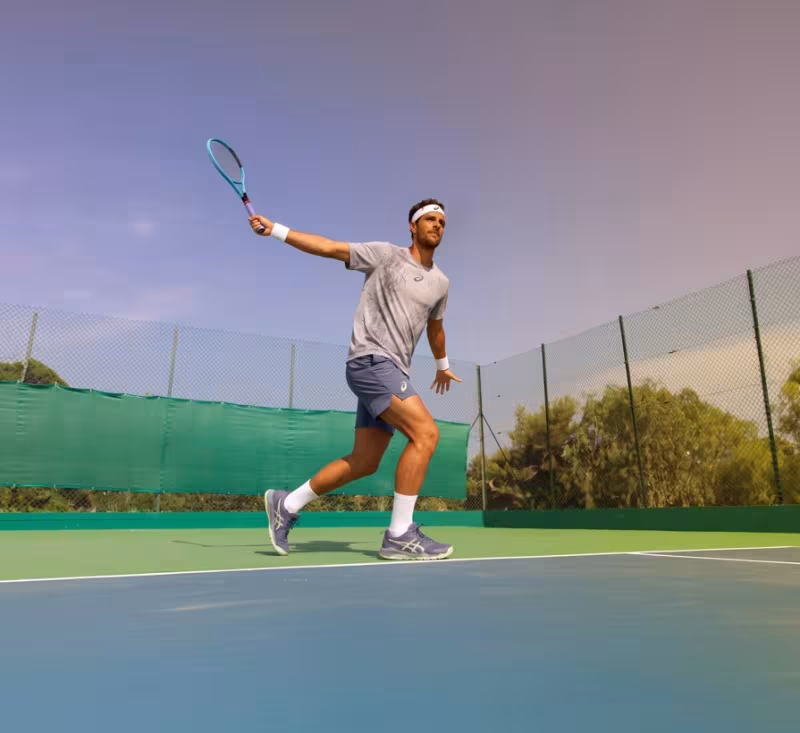
ASICS recommends shoes with good cushioning and lateral stability for this profile. Within their range, they position the GEL-RESOLUTION as an option for advanced players, the GEL-CHALLENGER for intermediate level, and the GEL-DEDICATE for beginner players. For a competitive tennis player who prioritizes stability and support, the GEL-RESOLUTION X is a good example of this philosophy.
If you play a lot, durability matters
Frequency also changes what you should look for. A player who competes regularly puts their shoes under much greater stress than someone who plays occasionally. Constant movements, stops, lateral foot placement, and repeated contact with the court cause wear and tear.
Therefore, durability must be part of the decision. ASICS emphasizes that good tennis shoes should be designed to provide lasting support during extended matches. On hard courts, moreover, abrasion makes it especially important to have a resilient sole and an upper capable of withstanding constant movement.
If you train several times a week and regularly compete, it’s not enough to just ask how a shoe feels during the first few minutes. It also matters how it will respond after accumulating many hours on the court.
If you are explosive, seek grip and traction
Another different profile is the player who bases a good part of their tennis on explosiveness. If you start quickly, attack short balls, move toward the net, or constantly change direction, you need the shoes to provide enough traction to accelerate, stop, and push off again.
In tennis, being fast does not just mean reaching a high speed. Often, we make two or three explosive steps, stop abruptly, and immediately change direction. To perform those movements with confidence, good contact between the sole and the court is essential.
ASICS identifies traction and ground contact as fundamental characteristics of tennis footwear due to the quick stops and explosive movements inherent to this sport.
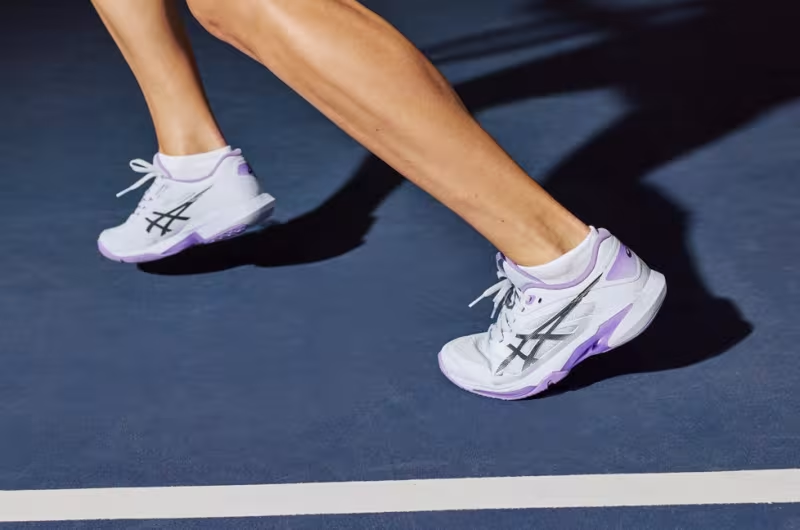
Lightweight and responsiveness to cover the whole court
If you are a player who does not just stay at the baseline and likes to use different areas of the court, your needs may change. Perhaps you defend from the back, but as soon as you find an opportunity, you move inside the court. Or you constantly look for angles, running forward and backward to cover lobs.
In that case, weight and responsiveness become more important. ASICS believes that all-court players can benefit from a lightweight shoe with good grip, precisely because they cover more ground and need the freedom to move in all directions.
For advanced players, the brand proposes the SOLUTION SPEED FF family; for intermediate level, SOLUTION SWIFT FF; and for beginners, GEL-GAME. Within the first group, the SOLUTION SPEED FF 4 is a particularly clear example for a player who prioritizes speed, lightness, and responsiveness.
What if you are an all-court player?
Not all players clearly belong to a single profile. You may feel comfortable building from the back while also changing your approach depending on your opponent. Some matches may force you to defend and others to play much more aggressively.
ASICS groups these profiles as players who combine different styles. For an advanced player who needs that combination, the brand suggests the COURT FF, a range designed to offer features from both worlds and adapt to players capable of modifying their tennis depending on the circumstances.
The surface also needs to come into play
A competitive player should not forget where they usually play. On hard courts, the durability of the sole and cushioning becomes particularly important. On clay, we need good grip, lateral support, and a sole that manages clay properly. On grass, due to its lower natural adherence, traction becomes even more relevant.
Therefore, even two players with a similar style may need different configurations depending on the surface they train and compete on.

What shoe do you need?
Ultimately, the choice starts from a much simpler question than it seems: what do you demand from your shoes when you play? If you build points from the back and need support during lateral movements, you should prioritize stability, support, and cushioning, with models like the ASICS GEL-RESOLUTION X as an example for advanced players.
If you constantly cover the entire court and your tennis depends on acceleration and quick changes of position, lightness, grip, and responsiveness gain importance, and an option like the ASICS SOLUTION SPEED FF 4 fits that profile.
If you mix both ways of playing, the COURT FF family offers a more balanced alternative. ASICS thus has different shoes for various levels and ways of competing. The key is first to identify your own needs.
If you train and compete regularly, choosing the right shoes is also part of your performance. Knowing what type of player you are, how you move, and what you need from your footwear will enable you to find an option tailored to your tennis. And making the right choice can help you enhance your feelings, move with greater confidence, and maximize your performance when you step onto the court.
This is an automatic translation. You can read the original news, ¿Qué deben buscar los jugadores de competición en unas zapatillas de tenis?