

How to Choose the Right ASICS Tennis Shoes for Your Playing Style
The movements and playing style of a player can influence their choice of footwear. Identifying which style best suits your way of moving can help you compete on the court.

Choosing tennis shoes should not rely solely on their design, comfort when trying them on, or even what your favorite player uses. The really important question would be: ‘How do you play tennis?’ Understanding your movement on the court can help you find footwear that better meets the demands of your game and helps you stand out against your opponents.
Not all tennis players move the same way. Some build points from the back, seeking a solid position before striking and spending much of the match performing lateral movements. Others need to cover more ground, constantly accelerate, reach for distant balls quickly, and move toward the net when an opportunity arises.
Therefore, ASICS primarily distinguishes between two styles of play when choosing your tennis shoes: stability and speed. Identifying which one you fit into can be the first step towards selecting footwear that is truly suited to what you do on the court.
First: Identify how you play tennis
Before thinking about a specific model, analyze your matches. Do you feel comfortable playing from the baseline? Do you build points patiently and need to feel well-supported when hitting? Do you make many movements from side to side? If so, your game likely has a significant component of stability.
On the other hand, if you are a player who tries to play forward, covers a lot of ground, changes direction quickly, or takes advantage of any short ball to come into the court, and you need to start quickly and react constantly, then speed probably carries more weight in your style of competition.
It does not mean that a baseline player never runs forward or that a quick player does not need stability. Tennis requires you to perform practically all types of movement. It is about identifying what movements dominate your game and what you need to enhance more frequently. This is where the choice of shoe really begins.
Stability: to control points from a solid base
ASICS encompasses the stability profile for players who tend to control rallies from the back of the court, relying on consistency and a solid position to execute their shots. In this type of tennis, prolonged rallies and lateral movements become especially important.
Think, for example, of a long point from the back. You hit from the advantage side, quickly recover to the center, move to the other side, and repeat the sequence several times. In that scenario, it is not only important to get to the ball. You also need to feel secure when stopping, supporting, and changing direction before the next shot.
For this profile, one of ASICS's benchmark models is the GEL-RESOLUTION X, the shoe chosen by Lorenzo Musetti.
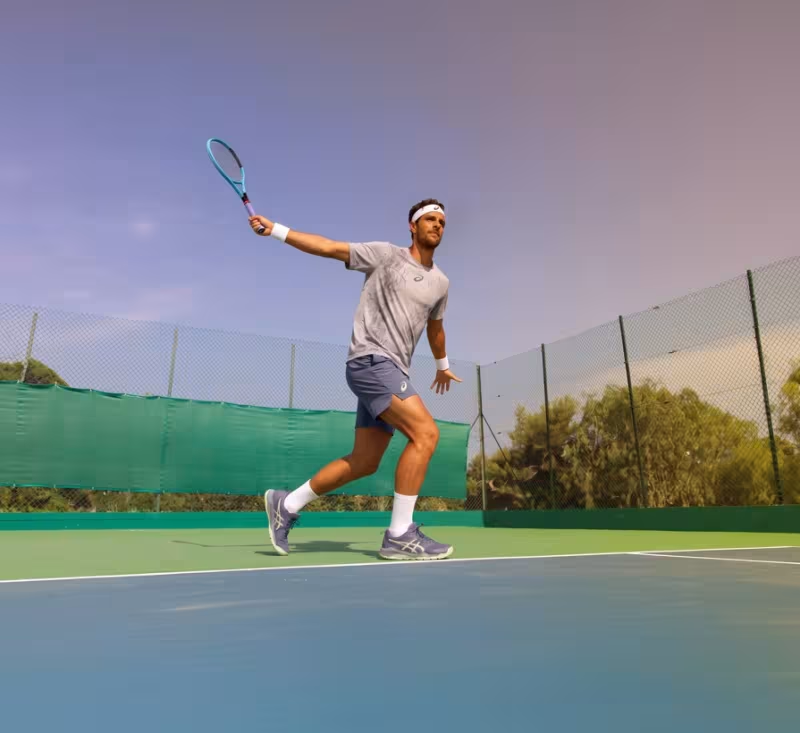
The shoe is designed to provide support and stability. Among its technologies is DYNAWALL, which extends from the midsole to the heel and aims to enhance stability during lateral movements. It also incorporates DYNALACING, designed to provide a secure fit, and FF BLAST PLUS cushioning, focused on maintaining comfort during prolonged rallies.
Therefore, if much of your tennis takes place around the baseline and you particularly value feeling a firm base when moving laterally and preparing each shot, your priority may be closer to stability.
Speed: when you need to get to each ball faster
There are players whose tennis demands a different type of response. They are those who seek to move quickly, cover a lot of space, and play forward. They need to react quickly to a short ball, accelerate towards a drop shot, recover position after hitting while running, or change direction to transition from a defensive to an offensive situation.
ASICS defines this second profile around speed and responsiveness.
In these cases, lightness becomes especially important. If your game depends on frequent sprints and you want to feel quick in your first steps, it makes sense to look for a shoe designed precisely to facilitate this type of movement.
Here the SOLUTION SPEED FF 4 appears as one of ASICS's main examples, the shoe chosen by Belinda Bencic.
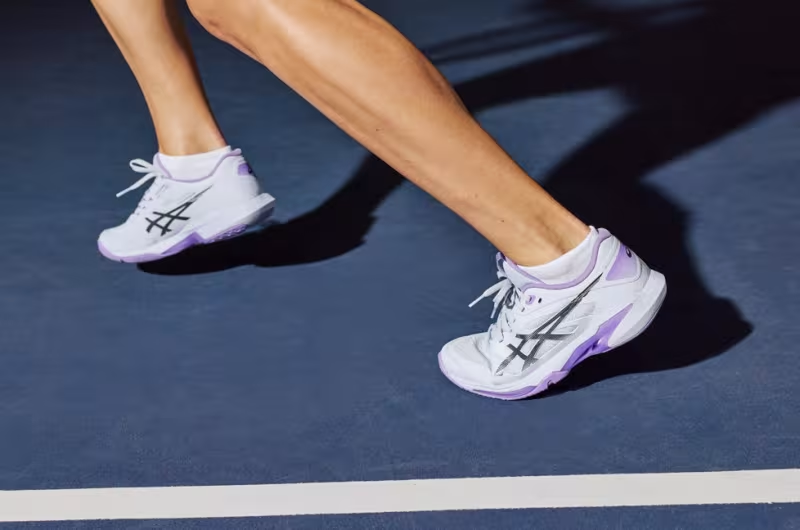
The model incorporates SPEEDTRUSS technology, developed to promote rapid acceleration during movements on the court. Its midsole uses FLYTEFOAM cushioning to combine comfortable landings with a lightweight feel, while the PRECISION-SOLE outsole, along with ASICSGRIP technology, aims to provide traction during quick movements and direction changes.
It is a different philosophy from the GEL-RESOLUTION X. Not because one shoe is better than the other, but because they cater to different priorities.
If you are someone who tries to get to every ball, accelerates constantly, and needs to move quickly around different areas of the court, your profile is probably closer to speed.
And what if my game combines stability and speed?
Not everyone fits perfectly into one of the two extremes. You might be a solid player from the back, but at the same time, often look for transitions to the net. Or feel that you need stability in rallies without wanting to give up a shoe that responds well when you need to accelerate.
For that more balanced profile, ASICS also offers alternatives like the COURT FF 3, designed for players who alternate different styles during matches. This model is specifically the shoe chosen by Novak Djokovic.
This model combines features aimed at both support and movement. It incorporates MONOSOCK to enhance foot support and TWISTRUSS, a technology designed to facilitate flexibility, acceleration, and recovery between shots. The key is to analyze your needs before making a selection.

The shoe should adapt to your tennis, not the other way around
A good way to make the decision is to mentally review your recent matches. Where do you spend most of your time? What movements do you repeat constantly? What do you value more when playing: feeling firm in lateral supports or feeling light when you have to accelerate?
If control from the back predominates and you need support during lateral movements, a shoe focused on stability, like the ASICS GEL-RESOLUTION X, may be better suited to your needs.
If your tennis particularly depends on acceleration, quick first steps, and the ability to cover different areas of the court, a speed-oriented model, like the ASICS SOLUTION SPEED FF 4, may fit you better.
And if you combine both characteristics, there are more versatile options like the COURT FF 3.
In the end, not all tennis players need exactly the same underfoot. To maximize your performance and ensure the best possible feelings during and after matches, it is important that the tennis shoe you choose is right for you and your way of playing.
Identifying your style first and then knowing the alternatives that ASICS offers can help you choose more wisely, make the most of your movements, and ultimately maximize your game and make a difference on the court.
This is an automatic translation. You can read the original news, Cómo elegir las zapatillas de tenis ASICS adecuadas para tu estilo de juego