

The Montreal tournament acknowledges the urgency of taking action: "We are falling behind"
Valerie Tetrault, director of the Montreal tournament, makes explosive statements of self-criticism and the need for changes if they do not want to lose the event.

Surprising and striking reflections have been made by Valerie Tetrault, director of the Montreal tournament, about the critical moment that the event is experiencing, the threats looming over its continuity, and the need for comprehensive changes to escape them.
Structural problems, problematic timing in the calendar, lack of a stadium with a retractable roof, complaints from fans, recurrent absences of major stars... The cocktail surrounding the Masters 1000 in Montreal is explosive and forces the organizers to make decisions. Recognizing a problem is the first step to solving it, but there is still a lot of work ahead, as can be gleaned from Valerie Tetrault's words, the director of the event held in the Francophone region of Canada.
Montreal has already received a warning from the ATP
"We had the opportunity to host a member of their executive team at the beginning of the tournament, and we sat down to discuss a little about the plan that the ATP is currently preparing for 2028. We know this will also be an important topic during the meetings that will take place during the US Open in New York," she confessed.
"The ATP recommended that we write a letter to the ATP board to explain a bit about what we are experiencing and how we feel, and to obviously explain our intention or our request, to ensure that it is a topic that is also discussed during those meetings," Tetrault pointed out.
Necessary structural changes for the tournament to remain in Montreal
Modernizing the facilities appears as another major priority. Montreal acknowledges that it is losing ground compared to other Masters 1000, and that both the ATP and the WTA have conveyed this concern.
"There is a sense of urgency. We really see that we are falling behind, and both circuits are telling us the same thing," admitted a woman aware that persistent rain wreaks havoc due to not having a single stadium with a retractable roof. To this, the absence of the best players in the world due to timing in the calendar adds up.
As if that were not enough, the fan experience has not been the best for years, with numerous protests about how comfortable the tournament is in aspects such as ticket purchasing, facility experience, etc.
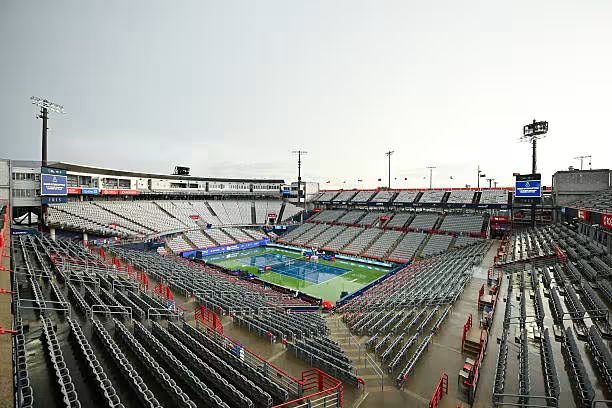
"It is quite clear that right now this is not a good place, and they are focusing more and more on the fan experience and what is expected from a fan's experience when attending a Masters 1000. They even conducted a small test during our tournament, bringing someone in to walk through the facilities and evaluate the fan experience as well."
"There is no ultimatum at this time. What they are looking for is for us to provide guarantees that we are working to find a solution," said the Canadian, aware that the sword of Damocles could be close to the event.
A new stadium that could be ready by 2032
The problem is that part of the current facilities are decades old. Tetrault noted that the southern area of the stadium "has not changed since the stadium was built in 1969."
"The clock is ticking," she warned. The organization's fear is investing large sums of money to renovate that area of the venue only for the final project to involve a complete transformation.
Therefore, Montreal is already considering a specific timeline: "If everything goes well over the next months and years, the earliest we believe the new stadium would be ready for us to use for the tournament would be 2032."
This timeline explains the current urgency. "You can see that, obviously, for projects of this magnitude, a lot of time is required. And that is why, when we talk about urgency to act, we need to start working right now," she stated.
The project that seems most viable includes "a three-season stadium with a retractable roof." The facility would allow for expanded usage options and host more sporting events.
Tetrault even provided specific examples: "Davis Cup and Billie Jean King Cup matches are quite interesting. If we had a stadium like that, for example, Canada vs. France would be in Montreal, at home, in our stadium. But without a roof, when you only have a few days to hold that event, it is too risky."
The rain, the big problem of this edition
The weather has also forced Montreal to face a huge operational challenge. "The rain. The rain at the beginning of the tournament, first because obviously it was not how we wanted to start the event, but also due to the volume of matches that needed to be played," she explained. And she wanted to emphasize the scale of the problem: "It wasn't just a little rain. It was a lot of rain for two days."
The picture painted by Tetrault is, therefore, quite clear: Montreal wants to remain a reference Masters 1000, but it needs modern infrastructures, a better experience for fans, and greater capacity to respond to weather adversities. The ATP is already involved in the discussions, and 2032 appears as a horizon for a possible new stadium, but the tournament itself admits that the time to act is now.
It remains to be seen if the ATP has the necessary patience for these measures to be implemented and if the Canadian tournament can find a way to reduce the outflow of favorites who do not attend the tournament in upcoming editions. It seems evident that this Masters 1000 is the most threatened and the upcoming reforms in the ATP calendar could leave it in a position of weakness.
This is an automatic translation. You can read the original news, El torneo de Montreal admite la urgencia de tomar medidas: "Estamos quedándonos atrás"