

Rafa Jódar: from the garage at home to the elite of world tennis
The Madrid native is having a spectacular season and dreams of making it to the ATP Finals. This is his incredible story.

Rafa Jódar took just a few months to go from being a name known primarily by those who followed junior and college tennis to becoming one of the great breakthroughs on the ATP circuit. But his story did not begin in a high-performance academy, nor surrounded by a large team of specialists. It started much earlier, playing with his father in their garage and learning a sport that, for years, was simply another way to have fun.
Born in Madrid on September 17, 2006, Jódar represents an unconventional path within modern tennis. He did not accelerate stages, he did not prematurely abandon his studies, nor did he build his career around a major academy. At 19 years old, after experiencing NCAA tennis in the United States, he has already been an ATP champion, a Grand Slam quarterfinalist, and world number 11, but much of the keys to that growth remain in the same place where they started: his family and the Club de Tenis Chamartín.
From a garage in Madrid to the courts of Chamartín
Jódar started hitting balls at just four years old. His first exchanges took place in the garage of his home, accompanied by his father, the same one who now travels with him on the circuit, making history and astonishing everyone with the precocity of his achievements. Later on, they also used a paddle court, whose dimensions made it easier for a child to start moving, controlling the ball, and understanding the game.
At that time, there was no major professional project behind him. Young Rafa liked sports in general. He played tennis, football, basketball, and simply enjoyed competing. His family, as he has explained himself, never forced him to specialize too early or pressured him to choose a specific path.
At six years old, he began attending the Chamartín Tennis Club. There some of his earliest memories related to the racket emerged. Hours on the hard courts with his father, many times just the two of them, training practically at any available hour.
Tennis gradually gained ground. Jódar continued to play football until he was about 11 or 12 years old, when he decided that the racket would be his priority. It was a choice of his own, not a family imposition. The best loves are the ones that come naturally.
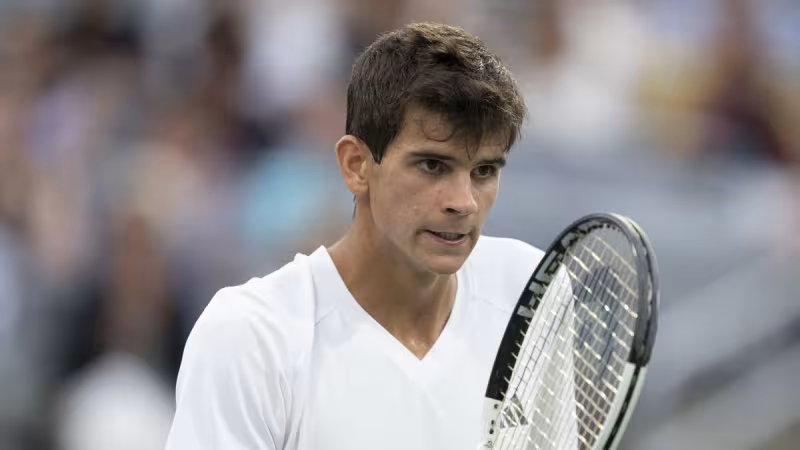
Rafael Jódar senior, much more than a father and coach
To understand Rafa Jódar's career, one must consider the figure of his father, also named Rafael Jódar.
The case is particularly special because Jódar senior did not come from the professional tennis circuit. He holds a degree in Physical Activity and Sports Sciences from INEF Madrid, worked as a Physical Education teacher, and had practiced basketball. With his son's athletic growth, he delved deeper into tennis until he became his coach.
Since Rafa decided to leave the University and tour the circuit, his father has simultaneously acted as his coach, physical trainer, and responsible for many of the decisions surrounding his career. He has also overseen management and communication issues. Hence, one of the most striking images of Jódar's breakout in 2026. While other players filled their boxes with coaches, physiotherapists, physical trainers, agents, and family members, in his, only his father could be seen.
The father's sports background helps explain this very limited structure. He does not just give tactical instructions. He also controls a large part of his physical training and has known since childhood how his body responds to training.
The connection between the two reaches the point where people from the Chamartín Tennis Club have explained that during some sessions they hardly need to speak. A glance can be enough for Rafa to understand what intensity or what exercise his father expects. At the club, they describe the player as tremendously analytical, almost scientific in the way he processes what happens on the court.
A family distanced from professional tennis
Another lesser-known detail is that Jódar is an only child of two teachers. He did not grow up in a family connected to the major circuits nor surrounded since childhood by former professional tennis players.
Even his name generates curiosity. Although Rafael Nadal ultimately became his great sports reference, Rafa Jódar is not named Rafael because of him. His father, grandfather, and great-grandfather already bore the same name. Moreover, the paternal branch of the family comes from Baeza, Jaén, where this family tradition dates back several generations.
Nadal would later have a huge influence as a role model. Jódar has particularly highlighted not only his results but also the Mallorcan's ability to maintain humility while becoming one of the best Spanish athletes in history.
The boy who went to the Caja Mágica to see his idols
Long before playing against the best in the world, Jódar was one of the many children from Madrid who attended the Masters 1000 in Madrid with their families.
There are two matches that particularly stayed in his memory: Grigor Dimitrov's victory over Novak Djokovic in 2013 and Nick Kyrgios's triumph against Roger Federer in 2015. The match between Dimitrov and Djokovic he would later define as one of the best he had witnessed live.
At that time, he was on the other side of the barrier. A decade later, it would be him competing at the Caja Mágica as one of the standout players in the draw.
Studies were never secondary
Jódar's progression also did not follow the usual model of many early talents who focus their entire adolescence exclusively on tennis.
He studied a Science Baccalaureate, with subjects like Biology and Chemistry, while continuing to train and compete. He has acknowledged that balancing both worlds was not easy, especially because his sports demands were far above those of most of his classmates.
The importance given to training also helps explain one of the most surprising decisions of his career. After winning the 2024 Junior US Open, instead of immediately jumping into the professional circuit full-time, he accepted a scholarship to study and compete at the University of Virginia.
Virginia, the decision that slowed down the rush and accelerated his maturity
The American experience was brief but decisive. Jódar arrived in Virginia in January 2025 and quickly became one of the standout players in college tennis. He finished with a record of 19 wins and three losses in singles, won 17 consecutive matches during a stretch of the season, and was named ITA National Rookie of the Year, as well as ACC Freshman of the Year and All-American.
The university gave him something he could not find merely by accumulating professional tournaments: independence. He had to live away from his parents, share living spaces with classmates, organize his day-to-day life, and constantly compete as part of a team. For the first time, moreover, his father stopped accompanying him daily as a coach, and the Virginia coaching staff took on that role.
Jódar even contemplated studying a career related to business, drawn by the prestige of the business school at Virginia.
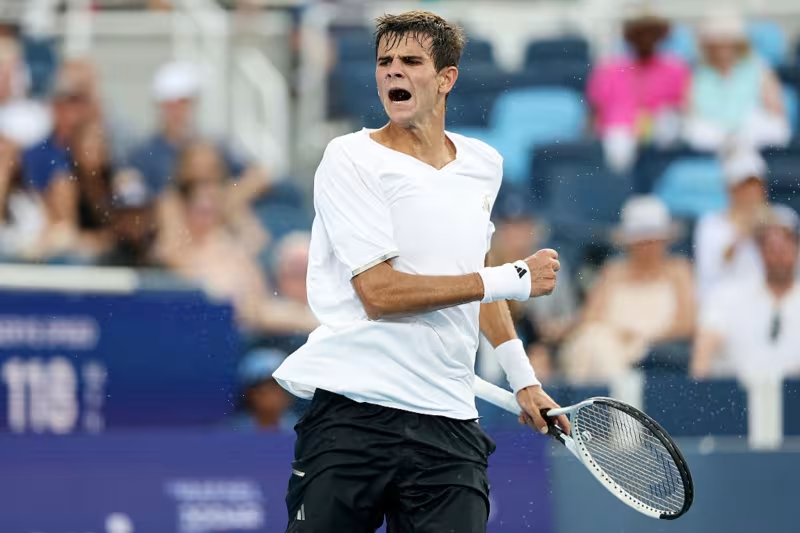
The Junior US Open that changed his dimension
Before Virginia, the first major international notice had arrived. In 2024, Jódar won the junior US Open after a week that definitively confirmed his potential. In the semifinals, he defeated, among others, the junior champion of Roland Garros, Kaylan Bigun, before lifting the title in New York.
He managed to rank as number 4 in the junior world rankings. However, even after winning a Grand Slam, he tried to downplay the significance of the result. For him, it demonstrated that he could compete against the best of his age, but there was still a huge distance to the professional elite. This way of interpreting success would be repeated later.
From Challengers to the first ATP title
In 2025, the transition began. He won three Challenger titles (Hersonissos, Lincoln, and Charlottesville) and ended up qualifying for the Next Gen ATP Finals, before announcing at the end of December that he was abandoning his university career to become a professional permanently.
The level change during 2026 was extraordinary. He started the year outside the top tier of world tennis, and in April, he won his first ATP title in Marrakech at only 19 years old. Then came the semifinals in Barcelona, the quarterfinals in Madrid and Rome, and, above all, a quarterfinals in his first participation at Roland Garros, where he eventually lost to Alexander Zverev. That spring was truly remarkable, growing exponentially from tournament to tournament.
The progression also did not fade when leaving clay courts. He reached the third round at Wimbledon, was a finalist in Washington, and made it to the semifinals of the Masters 1000 in Montreal. On August 10, 2026, he reached number 11 in the ATP ranking, the highest position of his career so far.
Now, fully engaged in the fight to qualify for the ATP Finals as Number 9 in the Race, despite suffering three consecutive losses (Cincinnati, US Open, and Tokyo), the player from Leganés dreams big about capping off a season that has been outstanding.
A career built without skipping the process
In less than two years, Rafa Jódar has gone from winning the junior US Open and being ranked 600th in the world to winning an ATP tournament, competing in the final rounds of Masters 1000 and Grand Slam events, and placing himself very close to the top ten players on the planet.
But probably the most unique part of his story lies behind the results. Because within that success and the hard work he puts into every tournament he attends is the child who hit balls in the garage of his home or the player who decided to move to Virginia when he could have turned professional immediately.
Rafa Jódar has reached the elite at an extraordinary speed. However, his journey was quite the opposite. It was slow, familial, and without too many shortcuts. And perhaps therein lies one of the main reasons why, when it finally came time to accelerate, he was prepared to do so.
Jódar's racket: HEAD Speed MP
The choice made by Rafa Jódar for his racket also fits with his way of understanding tennis. The player from Madrid uses a racket from the HEAD Speed MP family, although specifically adapted for competition, accompanied by HEAD Lynx Tour strings.
The Speed MP features a 100 square inch head, a 16x19 string pattern, and a weight of 300 grams unstrung, a combination designed to offer stability, controllable power, and ease of generating spin. Something that fits Rafa like a glove.
These characteristics are particularly well-suited for an aggressive player from the back of the court. Jódar looks to accelerate quickly, put weight on his shots, and take the initiative. The stability of the Speed MP allows him to respond better to fast balls and keep the racket firm during demanding impacts, while the open pattern facilitates producing topspin and playing with more margin over the net.
His balance between control and power is also noteworthy. Jódar generates a lot of speed on his own, so he needs a racket that allows him to attack without the ball flying too much. This is where the Lynx Tour comes in, a string designed specifically for control and spin.
Overall, his setup precisely enhances the main virtues of his tennis, and thanks to it, he is capable of producing the tennis that everyone already knows from him in 2026, based on deep shots, acceleration from the back, stability against powerful opponents, and the ability to play aggressively without giving up control.
This is an automatic translation. You can read the original news, Rafa Jódar: del garaje de casa a la élite del tenis mundial