|
28 Jul 2026 | 12.01
|
28 Jul 2026 | 12.01






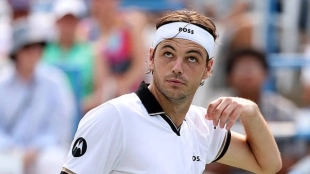
Taylor Fritz has started his journey in the ATP 500 Washington 2026 with a victory, overcoming Zizou Bergs in a match that marks a small step forward in a season plagued by persistent knee issues. The American admitted to Tennis TV that he is still working to eliminate the pain entirely and be able to compete normally during the crucial North American tour.
The situation is somewhat concerning because Taylor Fritz made a drastic decision months ago: he withdrew from the entire clay-court season to protect his knee and recover. However, Wimbledon confirmed that the issue had not completely disappeared. Now he needs to find a delicate balance between strengthening his knee and competing, aware that regaining rhythm through matches is also part of the process.
Taylor Fritz acknowledges that he still feels discomfort in his troubled knee
Fritz doesn't hide the fact that the experiences at Wimbledon were far from ideal. His physical condition once again limited him at a crucial moment of the season, and Washington now marks the beginning of another attempt to gain consistency. "That match at Wimbledon hurt me. I'm still working on my recovery, but I also need to play tennis," admitted the American, aware that staying indefinitely away from competition is not necessarily the solution.
That's where the complexity of the moment lies. Fritz needs to strengthen his knee and reduce discomfort, but he also needs matches to regain automatism, confidence, and competitive form. The North American tour could serve to determine if both needs are compatible.
"I hope it's a temporary situation and that I can manage everything better, that the pain goes away completely," he affirmed. Above any sporting goal, that's his main wish for the coming months.
Skipping the entire clay-court season did not completely solve the problem
The decision not to compete in any tournament during the European clay-court swing illustrated how much Fritz prioritized his physical recovery. Sacrificing such a large part of the calendar meant losing competitive rhythm and opportunities to earn points, but it was meant to allow him to face Wimbledon and the second half of the year in better shape.
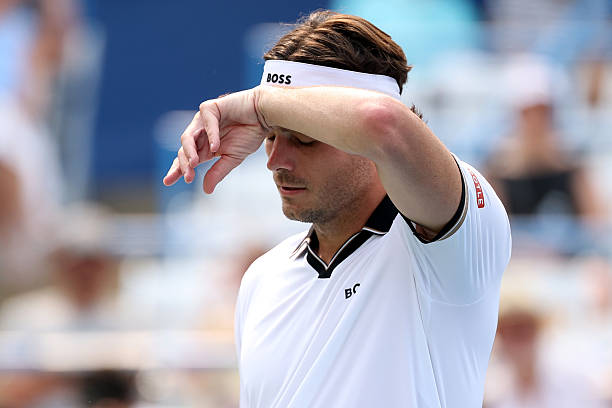
The outcome was not as expected. Although he managed to return, the knee issues resurfaced in London, confirming that the recovery needs more time. This now requires careful management of training loads, matches, and rest. "My season isn't too bad considering all the knee problems I'm having," reflected Fritz, trying to put into perspective results that must inevitably be analyzed taking into account his physical limitations.
The American has managed to stay competitive even without the continuity he desires. It is precisely for this reason that there is a sense that, if he can eliminate these discomforts, he still has enough margin to prove once again that he belongs to the world elite.
Washington, a starting point to regain confidence
His victory against Bergs holds significance within that context. It's not just about advancing to a round in an ATP 500, but about seeing how his body responds to competition and starting to accumulate minutes on a surface where he has historically displayed some of his best qualities.
Fritz finds in hard courts conditions particularly suitable for his strong serve and aggressive tennis. If he can move freely and fully trust his movements, the North American tour should offer him significant opportunities.
Moreover, playing in the United States introduces an added emotional component. Washington could be the place where he rebuilds his confidence before facing even bigger commitments, with the Masters 1000 and, especially, the US Open looming on the horizon.
Fritz boils down all these objectives to an essential condition. "I just want to be healthy for the rest of the year after skipping the entire clay-court season," he concluded.
Fritz needs to compete again without constantly thinking about his knee
That seems to be the real challenge. Beyond rankings, titles, or specific results, Fritz needs to reach a point where his knee is no longer part of every analysis of his game. As long as there is pain, determining his true level will be difficult.
The hope is that competition itself will contribute to progressively strengthening the joint, allowing him to better manage the loads until the discomfort disappears. The process will need to be carefully monitored, especially in a calendar stretch filled with important events.
Fritz has reasons to remain optimistic. Even going through a season full of physical difficulties, he continues to be a player capable of competing at a high level. His experience, serve, and ability to perform on hard courts make him a dangerous opponent in the coming weeks if his body responds.
Washington offers a first positive sign. The win over Bergs allows him to keep accumulating matches and look ahead, but the most important outcome for Taylor Fritz will be finishing each match without pain. If he achieves that, he still has time in 2026 to remember why he has been part of the world's best tennis players for years.
This news is an automatic translation. You can read the original news, Fritz sigue transmitiendo dudas respecto a su rodilla: "Solo espero que esto sea temporal"
-
 27 Jul 2026 | 15:00Vagnozzi recalls Sinner's collapse at Roland Garros and explains the cause
 -
 28 Jul 2026 | 15:00Zverev has a real opportunity to be world number 1
 -
 27 Jul 2026 | 12:00Schedule and where to watch Rafa Jódar's debut in Washington, against Fils
 -
 27 Jul 2026 | 16:00Osaka: "I don't want to be famous"