

The keys for Dani Mérida to win his first ATP title in Umag against Dzumhur
We analyze what can be expected from the final in Umag, where Dani Mérida could join the list of Spanish tennis players who have won an ATP title.

The final of the ATP 250 in Umag 2026 will see Dani Mérida and Damir Dzumhur face off this Sunday in a duel that could mark a turning point in the career of the young Spanish player. After an outstanding week on the Croatian clay, Mérida will play his second ATP final.
Beyond the generational contrast, the final brings together two players with very similar profiles from a competitive standpoint. Both stand out for their ability to construct points from the baseline, their consistency, mental strength, and tactical acumen in critical moments. Everything points to a long, intense match full of demanding exchanges, where small details could tip the balance in one direction or the other.
Dani Mérida, the chance to confirm his definitive breakthrough
Few could have imagined a few months ago the speed at which Dani Mérida would establish himself as one of the great revelations of Spanish tennis. The player from Murcia continues to take giant strides and in Umag has once again shown that he is no longer satisfied with competing on equal terms against established players on the ATP tour. Now he aims to beat them regularly.
His journey during the week has been a demonstration of maturity. He has managed to overcome challenging moments, remained calm under maximum pressure, and progressively raised his level as the tournament progressed. Every victory has reinforced the feeling that his tennis is beginning to find a stability uncharacteristic of such a young player, essential to aim for titles at the highest level.

This will be his second ATP final of his career, after the one he contested a few months ago in Bucharest, where he ended up losing to Mariano Navone. That experience, far from becoming a disappointment, can now result in a valuable learning opportunity. Facing a final always entails a different emotional challenge compared to the rest of the tournament matches, and having already experienced that pressure can help him manage the nerves much better in the initial phases of the match.
Winning the trophy in Umag would mean much more than securing his first ATP title. It would confirm that his growth is no longer solely based on potential but also on competitive reality. Spanish tennis has been searching for new references for the next decade, and Mérida is proving, tournament after tournament, that he possesses the necessary tools to establish himself among the best in the world.
Damir Dzumhur, a veteran who turns every match into a battle
On the other side will be one of those players who never receive the recognition they probably deserve. Damir Dzumhur has been competing at the highest level for over a decade thanks to a combination of tactical intelligence, competitive character, and an enormous ability to adapt to any situation that a match presents.
The Bosnian has equally had a great week in Umag, defeating significant opponents and showing that he remains a tremendously challenging competitor on clay courts. He doesn't need to dominate with constant winners to prevail. His game is about wearing down the opponent, forcing them to play an extra shot, and seizing any slight lapse to completely change the match's dynamic.
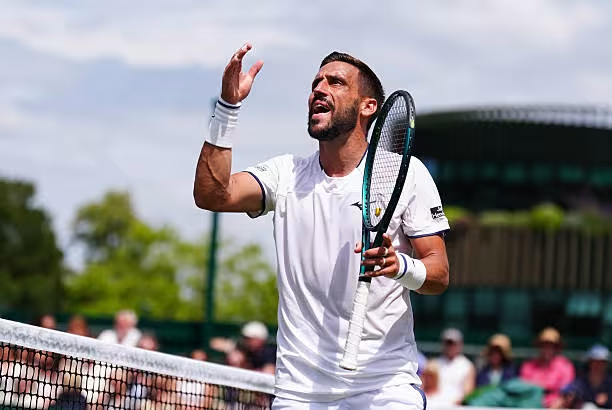
His experience could become one of the most important factors in the final. Dzumhur knows perfectly how to manage moments of tension, when to slow down the pace, when to accelerate, and how to take advantage of every small opportunity. Additionally, he has a much broader technical repertoire than is typically recognized. He alternates heights, speeds, and directions with great ease, incorporates drop shots at the right moment, and can turn an apparently neutral exchange into a clearly advantageous situation.
Therefore, Mérida will have a rival in front of him who will demand maximum concentration in every point. Against a player like Dzumhur, it is practically impossible to maintain initiative continuously. Patience will be as important as aggressiveness.
Tactical keys: a war from the baseline
Everything suggests that the final will be marked by long exchanges and high physical wear. Both Mérida and Dzumhur feel very comfortable constructing points from the baseline and neither tends to gift unnecessary errors. This will force both to carefully craft each attack before finding the definitive opportunity to close out points.
In such a context, the return can become enormously important. Both are excellent returners, and we are likely to see numerous closely contested games and multiple break opportunities. Therefore, getting some free points with the serve will make a difference. It won’t be necessary to have a phenomenal ace percentage, but rather to prevent the opponent from constantly engaging in exchanges from a comfortable position.
Handling pace variations promises to become a decisive aspect. Dzumhur tends to disrupt the rhythm of rallies with changes in height, heavier shots, or well-executed drop shots – resources that can take Mérida out of his comfort zone if the Spaniard becomes overly predictable.
For Mérida, the key will likely be to assume a slightly more proactive role. When he manages to control points with his forehand, he should dare to accelerate, seek greater depth, and not settle for endless exchanges against an opponent who enjoys precisely those types of matches. Likewise, coming to the net after constructing the point correctly can be a valuable resource to shorten rallies and prevent Dzumhur from finding time to regroup defensively.
Ultimately, the feeling is that the victor will be whoever manages to impose their identity from the baseline without relinquishing the introduction of variations when demanded by the match. If Dani Mérida can combine his power with the necessary patience to choose the right moments to attack, he will have a fantastic opportunity to claim the first ATP title of his career. If, on the other hand, the match becomes a tactical survival exercise and a test of mental endurance, few players on the tour are better equipped than Damir Dzumhur to emerge as the winner.
This is an automatic translation. You can read the original news, Las claves para que Dani Mérida conquiste su primer título ATP en Umag ante Dzumhur