

The question every summer: Can Djokovic win Wimbledon again?
Andy Roddick has once again brought to the table the debate about the Serbian and the pursuit of the #25 Grand Slam. For the former world number 1, Wimbledon brings many positive points to consider the Serbian's candidacy.

Andy Roddick has once again focused on the eternal debate of modern tennis: who truly dominates the grass of Wimbledon and why Novak Djokovic remains, even with the passing of time, a serious threat for the 2026 title. In a recent conversation about the peculiarities of grass-court play, Roddick elaborated a clear defense of the Serbian's candidacy, basing it not on nostalgia, but on the logic inherent in the sport.
The former world number one starts from a key idea: grass does not reward the same type of tennis as clay or hard courts. While physical exchanges and topspin usage dominate the rhythm at Roland Garros, at Wimbledon the margin for reaction is drastically reduced. According to Roddick, this difference completely transforms the circuit's hierarchies. "On grass, you can get out of tough situations by hitting the ball better than on any other surface," he points out in his analysis, emphasizing that the game is decided more on the first shot than on point construction.
In this context, the figure of Novak Djokovic takes on special significance. For Roddick, the Serbian embodies like few others what he calls "first-strike tennis": precision in returns, the ability to hit deep and neutralize the opponent's serve without the need for long exchanges. On grass, where low bounce reduces reaction time, that skill is amplified. A solid return down the middle, explains Roddick, not only neutralizes the serve but also forces the opponent to play more directly and predictably, something that Djokovic has perfected over the years.
Another element that Roddick highlights is the efficiency of movement on grass. Unlike other surfaces, where braking and lateral movements are constant, at Wimbledon, oftentimes the best resource is to follow the shot direction, advance half a step, or even a full step. Djokovic, with his elasticity and ability to adjust his body in milliseconds, fits perfectly into that pattern. It's not about running more, but about moving better and earlier.
Djokovic's return, key to understanding his candidacy at Wimbledon
Roddick also dispels the myth that grass only favors big servers. Although the serve remains important, the modern reality of the tournament shows that the best returners have gained prominence. In that sense, Djokovic not only competes but redefines the standard. His ability to return even difficult balls deep eliminates the opponent's time and turns each game into a immediate execution duel.
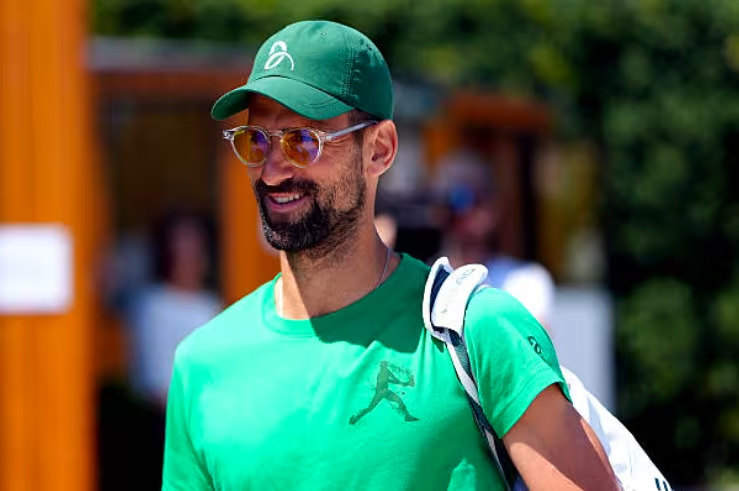
The conversation gains even more relevance when the competitive context is introduced. With uncertainty about the form of figures like Jannik Sinner and the ongoing generational transition, Roddick suggests that Djokovic can read the landscape clearly. Even without being at his most dominant physical peak, the Serbian can build a competitive narrative in his favor at Wimbledon.
Ultimately, Andy Roddick's defense is not sentimental but strategic. For him, Djokovic not only remains a contender in 2026; he is, by the pure logic of grass, one of the most dangerous names in the tournament. On a surface where details weigh more than endurance, Novak Djokovic's tennis fits too well to be ignored.
This is an automatic translation. You can read the original news, La pregunta de cada verano: ¿puede Djokovic volver a ganar Wimbledon?