

The difference in prize money between the Queen's tournament for men and women reopens a controversial debate
The British tournament has increased the prize money in its women's tournament by a lot, but women are still receiving much less money than men.

Tennis is considered the most gender equal sport in terms of prize money between men and women, and it's not without reason. That's why cases like that of the Queen's tournament stand out, where despite a significant increase in the prize money for the WTA tournament, the figures are much lower than what the ATP circuit players will earn this week. Why does this happen?
One of the most emblematic and iconic tennis clubs in the world opened its doors to women's tennis last year, a piece of news that was widely celebrated. Queen's stands out as the hub of world tennis during two weeks of this grass court swing, hosting a WTA 500 tournament, recently won by Donna Vekic, and an ATP 500 tournament featuring some of the best male players. Both tournaments are played on the same courts, have the same category, and the same number of participants, yet the prize money varies significantly.
The numbers speak for themselves. Although the organization increased the prize money for the women's tournament by 35.34% compared to the previous edition on the WTA calendar, female players are still receiving considerably lower amounts than the men competing in the ATP 500 at Queen's this week. This is the case even though both events share the exact same category within their respective circuits.
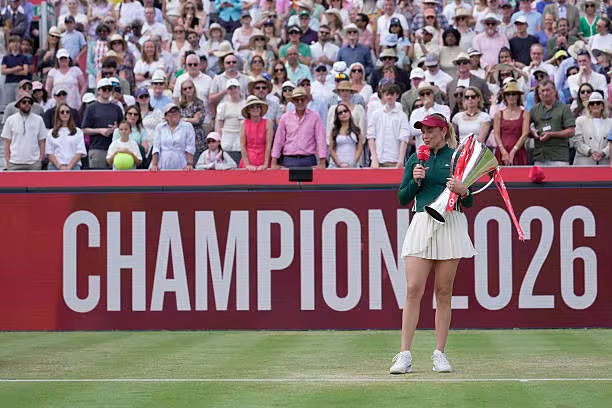
Many fans find it hard to comprehend. How is it possible for an ATP 500 and a WTA 500 to offer such different prizes? Especially when in the four Grand Slam tournaments and in those where men and women compete simultaneously, the prize money distributed is identical. The answer is more complex than it seems.
Prize money at Queen's: how much men and women earn at each round
The numbers reveal a clear reality. Despite a significant effort to increase the prize pool for the women's tournament, differences remain significant, especially in the later rounds. The winner of the women's tournament receives $294,445, whereas the male champion will receive $556,747. The gap is maintained across almost all rounds, with some interesting nuances.
| Round | WTA Queen's 2026 ($) | ATP Queen's 2026 ($) |
|---|---|---|
| Champion | 294,445 | 556,747 |
| Runner-up | 181,745 | 299,539 |
| Semifinals | 104,770 | 159,634 |
| Quarterfinals | 53,135 | 81,557 |
| Round of 16 | 28,245 | 43,535 |
| First round | 20,160 | 23,214 |
What stands out is that the differences are much smaller in the early rounds compared to the later ones. A female player eliminated in the first round earns just 15% less than a male player. However, when reaching the trophy, the difference widens to almost 90%. It reflects a specific economic reality: the organization values the commercial worth of the men's tournament as superior, especially in the decisive phases of the event.
Gender equality in tennis: the most advanced sport in terms of parity
Before jumping to hasty conclusions, it's crucial to introduce a fundamental nuance. Tennis is perhaps the most gender-equal sport in the world when it comes to prize money between men and women.
The four Grand Slam tournaments pay the exact same amounts to both male and female champions. Wimbledon, Roland Garros, the US Open, and the Australian Open distribute the same sums regardless of the contestants' gender. This equality also extends to many major combined tournaments where the ATP and WTA share venue, dates, sponsors, and organizational structure.
Indian Wells, Miami, Madrid, or Rome are examples of events where economic differences have vanished or are in the process of disappearing. This is why Queen's is of particular interest from an analytical standpoint.
We are not facing a situation where men and women compete simultaneously in the same commercial product. These are two separate tournaments, held in different weeks, with distinct television agreements, sponsorship contracts, and independent commercial dynamics. And it's precisely there where differences reappear.
The 35% increase in the women's tournament: a hidden news piece
There is another data point that rarely surfaces in the debates but deserves attention. While the male ATP 500 tournament has increased its prize money by approximately 2.4% from the previous year, the women's tournament has witnessed a surge of over 35% across all rounds.
The winner now receives $294,445, a 35.07% increase. The runner-up has seen a 35.37% rise in prize money, while the semifinalists receive 33.59% more than the previous edition. Even the first round eliminated players get 34.22% more.
The direction the tournament is taking is clear. This second edition could offer such increases due to the positive response from the London audience to the return of women's tennis at the legendary Queen's Club. This reaffirms the positive trajectory of the WTA circuit and highlights missed opportunities in terms of promotion and business attributed to the inefficiency of the governing body.
Why does the WTA generate less revenue than the ATP?
This is where the most delicate part of the debate emerges. Advocates of the current model argue that prize money should be linked to the revenues generated by each competition. If a tournament sells more tickets, secures more lucrative television contracts, and attracts more sponsors, it's logical for it to have a higher economic purse.
The question then changes entirely. It's not about why women earn less at Queen's. The real issue is why women's tennis generates less revenue when marketed independently, without the cohesive structure seen in Grand Slams or Masters 1000/WTA 1000 events where men and women compete simultaneously.

Market factors play a significant role. Historically, the ATP tour has enjoyed higher viewership, more media impact, and a superior ability to attract global sponsors. However, attributing all responsibility to lower public interest would be overly simplistic.
The WTA itself must shoulder a significant portion of blame in this scenario. Over the years, the organization has struggled to effectively promote its product. Building rivalries, creating narratives, positioning its top players, and commercial exploitation of its stars have fallen well below expectations for a circuit boasting such sporting talent.
While the ATP successfully turned the era of Roger Federer, Rafael Nadal, Novak Djokovic, and Andy Murray into a global saga transcending tennis, the WTA has had difficulties crafting similar stories around some of the best generations of female players in history.
This is particularly striking given the wealth of talent present. Serena Williams, Maria Sharapova, Ashleigh Barty, Iga Swiatek, Aryna Sabalenka, Coco Gauff, or Mirra Andreeva are names with enough potential to attract massive audiences. Yet, the feeling is that the women's circuit has often failed to maximize their stars' impact.
One irrefutable evidence of this is the significant obstacles for a Spanish fan to watch women's tennis beyond the Grand Slams. There is no powerful television platform that has acquired the rights and truly invested in a product brimming with potential but lacking in promotion and development by the WTA.
Rumors of a potential merger between the ATP and WTA, circulating for some time, stem precisely from this context. Both circuits would fall under the same organizational umbrella, attempting to elevate women's tennis to the same level as men's in terms of communication, marketing, promotion, and off-court personality-building—factors that have significantly driven the male tennis circuit's development for decades.
The WTA's major challenge in achieving economic equality
Perhaps the most compelling discussion now is not about whether men and women should earn the same. Most fans would likely answer affirmatively. The real question is how to ensure that women's tennis generates the revenue necessary to sustain equality across all tournaments, even when not sharing the stage with the ATP.
Because the Grand Slam examples demonstrate that wage equality is perfectly feasible with organizational determination and a sufficiently solid economic structure.
Queen's reflects a different reality. It portrays a growing women's product, with a remarkable increase in prize money and huge potential for further growth. However, it also underscores a significant distance remaining regarding the commercial value attributed to the men's circuit.
Tennis has made strides in gender pay equality surpassing most other sports. Nevertheless, the scenes witnessed at Queen's over these two weeks suggest that significant questions remain unanswered.
And perhaps the most crucial one of all is this: if women's tennis possesses so much talent, competitiveness, and stories capable of connecting with audiences, why hasn't it yet managed to generate the same economic value as the men's side when both compete separately? The answer to this question will shape much of the WTA's future in the next decade.
This is an automatic translation. You can read the original news, La diferencia entre el prize money del torneo de Queen´s a hombres y mujeres reabre un polémico debate