

Analysis of the Roland Garros 2026 final: The tennis Olympus awaits Zverev or Cobolli
German and Italian will face off in the title duel in Paris. We break down the keys to a final in which tennis will meet, regardless of the outcome, a new Grand Slam champion.

If we were to survey tennis fans on how viable they would find a Roland Garros 2026 final between an Italian and Alexander Zverev, the response would be overwhelmingly positive. Different sides of the draw, rock-solid number two seed... but what they didn't expect, of course, was for the Italian on the other side of the net not to be Jannik Sinner, but instead to show up in the form of Flavio Cobolli, who has pushed his limits in Paris. The chaotic Grand Slam will conclude with a new Major champion, a new member for a tennis Olympus increasingly exclusive among eras dominated by the Big Three, Carlos Alcaraz, or Jannik himself.
Embracing the chaos of the first week, the last days of competition have blended great moments with gray clouds that have slightly disrupted the spectacle. The withdrawal of Matteo Arnaldi left us without a semifinal before it even began, injuries also plagued Matteo Berrettini so he couldn't finish his quarterfinal match, and we've set aside five-set matches in favor of the superiority shown by players like Sascha or Flavio. Could the final be a grand finale to compensate for what we've seen in the past few days? In terms of level and spectacle, absolutely... but the reality is that nerves and pressure could (and should) define this final.
Zverev wants to right a wrong: keys to becoming a champion
Alexander Zverev experienced it for the first time in an event like this back in 2020. His performance at 5-3 and serving in the fifth set of the US Open final against Dominic Thiem exemplifies how mortals often tremble at the doors of the gods, enveloping that match in a surrealistic aura that both frustrated and delighted viewers alike. He has grown a lot since then, the German player has... although one thing remains unchanged: he still hasn't clinched a Grand Slam title.
Always at the gates facing players who are more determined, generational, and complete than him, the scenery for the German changed the day Jannik Sinner's body decided to abandon him. A step forward was demanded of him, and it has materialized: we have seen a dominating Sascha, striking with power on the forehand, unafraid to take the initiative against young rivals who felt his authority. He came back from 2-5 down in the first set against Jódar in the quarterfinals, saved numerous break points at the start of the match against Mensik in the semifinals to take control shortly after... in essence, against rivals venturing into unexpected territory, Sascha has been able to assert his status and experience, foreshadowing a positive outcome against a rival in a similar situation.
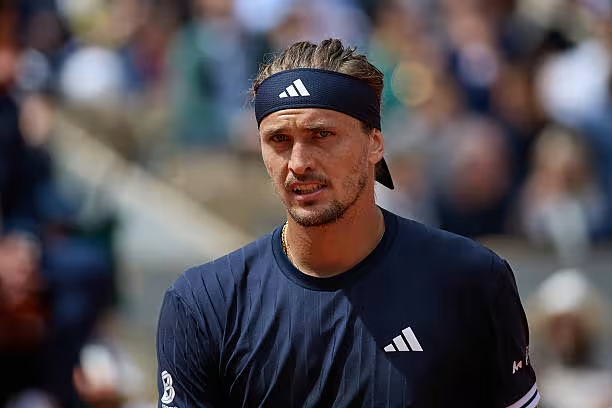
But Zverev should not be overconfident: Cobolli already knows what it's like to defeat him. Although the head-to-head record is 3-1 in favor of the German, and he already defeated him at Philippe Chatrier last year, Flavio dominated their second-to-last match in Munich from start to finish (6-3, 6-3), indicating that on a good day, he has more than enough tennis to challenge Zverev from the baseline. On that day, Sascha didn't take advantage of his strengths and, in cold and slow conditions, felt the inconsistency of his forehand and his lack of energy on serve, aspects that Cobolli will seek to exploit.
His strong serving has been one of the key factors in his flawless run in Paris... and seems even more crucial in this final. A high percentage of points won on first serves would allow him, firstly, to calm the nerves typical of an event like this; secondly, to add a weapon and a cushion that Flavio usually lacks; and finally, to dictate the pace of the match in the style he prefers, with quick service games followed by being a defensive wall, wearing down his opponent's legs and establishing strength from the parallel backhand zone.
However, there is no more winning tactic for Zverev than having a good level of determination, an intangible that becomes highly relevant in an event like this. We have seen him hit his forehand fearlessly against Mensik and Jódar, but a Grand Slam final can make anyone doubt, and the forehand has always been Zverev's way out in crucial moments. It was through that side that Cobolli, furthermore, controlled him on German soil: Sascha has a task if he wants to achieve the greatest success of his career.
On to the finals. Relive today's best moments of the day by @emirates ✈️#RolandGarros #Emirates #FlyBetter pic.twitter.com/YmfclaTvWC
— Roland-Garros (@rolandgarros) June 5, 2026
Cobolli seeks to make history: the keys to becoming champion
The progression of Flavio Cobolli on the ATP circuit has been slow but steady. Gradual, constant, with no major peaks but no setbacks either, steadily improving all aspects of his tennis and emerging as a threat that multiplies on natural surfaces (clay or grass). He had already reached the quarterfinals at Wimbledon, but reaching the final in Paris is an unprecedented success: if there is someone who should play freely, it is him, invited to a party that was not on many people's radar.
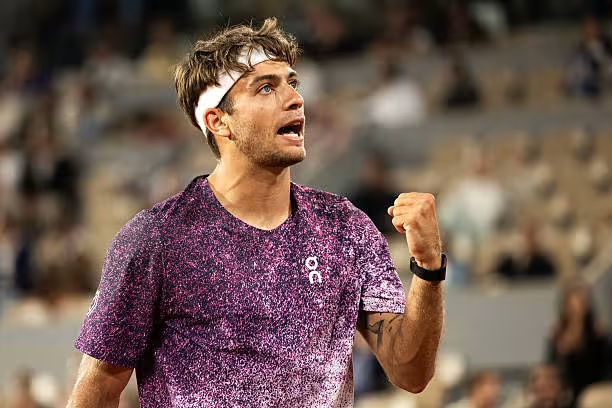
His path to the title match has been nothing if not eventful, but he certainly should not be held accountable for it. Two victories over top-20 players (a still inexperienced Tien on this surface and Aliassime, his toughest opponent towards the final) and an advantage of not having played the semifinal due to Arnaldi's withdrawal, which he hopes does not become a double-edged sword (imagine facing a Slam final without any competitive rhythm, completely cold, after your last match was on Wednesday).
Does he have what it takes to defeat Sascha? The semifinal match in Munich proves that he does. The keys that day were very clear: he managed to put a lot of pressure on the German's first serve, stealing a very high percentage (almost 40%) of points from the defense (what bothers Zverev the most is when players like Sinner or Carlos force him to end the point beyond the serve consistently; Flavio achieved this that day); he held his ground in cross-court backhand exchanges, varying heights and creating angles, to then attack with full force on the crosscourt forehand side (in fact, he consistently exploited that gap, making it the shot that made the difference) and showed the determination that the German lacked in dealing with short balls and coming aggressively to the net.
Flavio must do many things, but here are his key points: make Sascha hit as many forehands as possible, create short angles that force the German to move laterally, be proactive when returning to nullify the opponent's free points with their serve, and, as we mentioned with his opponent, show the determination and conviction necessary if you want to be crowned Grand Slam champion.
The occasion may come a bit early for Cobolli, with little experience in the final rounds of Masters 1000 or Grand Slam events... but as they say: it's never too early if it brings happiness (in the chaotic Roland Garros, tweaking proverbs doesn't seem like a bad plan). Being the dark horse of the tournament, watching the pressure sit on the German's shoulders, and the freshness in leg movement he'll enjoy are strong reasons to bet on Flavio in a final that opens up two paths: one of nerves, pressure, and survival... or one of fresh, flashy tennis with big shots that these two players have shown us in the past. Which will weigh more? Who will prevail over everything and everyone to lift their first Grand Slam trophy? Whatever happens, tomorrow we will witness tennis history: so get comfortable and enjoy.
This is an automatic translation. You can read the original news, Análisis de la final de Roland Garros 2026: El Olimpo del tenis espera a Zverev o Cobolli