

These are the differences between the various clay court tournaments
Montecarlo, Madrid, Rome, and Roland Garros can be played on the same surface, clay, but they are very different from each other. These are their differences.

As we approach the clay season, many are already looking towards the major tournaments on this surface, with Monte Carlo, Madrid, Rome, and Roland Garros as the events that everyone wants to win. The truth is that, despite sharing the same surface, these tournaments have little in common.
To understand the differences between these tournaments, we must consider two key factors that directly impact the playing style on clay courts: altitude and climate. Depending on each of these factors, the style of play can vary, benefiting and hindering different types of players.
Monte Carlo Masters 1000
Altitude: 19 meters above sea level
Climate: generally high temperatures
It is the Masters 1000 event that most closely resembles what is found in Roland Garros, provided it coincides with hot days. Otherwise, it may bear more resemblance to Rome.
When the temperature reaches around 25ºC or higher, the conditions closely resemble those in Paris: the ball bounces high, and the game becomes more typical of clay courts. The main difference lies in its central court, which is smaller, limiting the space to move around.
However, being held in April, there is a possibility that it coincides with cooler days, below 20ºC, with overcast skies or even some rain. In fact, a somewhat chilly week is expected in Monte Carlo for this 2026.
In such circumstances, the ball bounce decreases, causing the game to become slower and heavier, making it harder to move the ball. We recall how much Rafael Nadal struggled on such days due to the damage caused by sun and heat, affecting the ball's trajectory.
• With heat: benefits players who apply a lot of topspin and dominate from the baseline.
• In cold, cloudy, or rainy conditions: favors more offensive players who approach the net or strike flatter and lower.

Mutua Madrid Open
Altitude: 667 meters above sea level
Climate: usually hot
It is the most atypical tournament on the entire clay court circuit. The ball sensations here are entirely different from the rest. Being played at almost 700 meters altitude, the ball travels faster through the air.
In these conditions, the air density is lower, reducing control and increasing the speed of shots. Therefore, players often adjust their string tension upon arriving in Madrid, seeking the right feel with the ball. The early rounds are crucial for adaptation, and this is where more surprising defeats can occur.
To balance this increased air speed (especially during daytime and sunny conditions), the organization uses slower clay than in other tournaments. This is their way of compensating, making Madrid a rather unique event on this surface.
• Favored players: those with a strong serve and a more direct, flat, and aggressive game from the baseline.
• Disadvantaged players: those who prefer slower paces and longer rallies.
This explains why Rafael Nadal has not dominated this tournament as he has in other clay events. Conversely, it suits Carlos Alcaraz perfectly, as he can alternate between defense and attack effectively, being equally dangerous in both aspects.

Rome Masters 1000
Altitude: 25 meters above sea level
Climate: warm but quite humid, making the atmosphere heavier
Due to its characteristics, Rome should closely resemble Monte Carlo or what is seen in Paris, but the most influential factor affecting the tournament is the climate.
It is common to have cloudy days or even rain, directly influencing the gameplay: the court becomes slower, and the ball heavier. Additionally, the clay has certain peculiarities causing somewhat irregular bounces, which can be uncomfortable for those coming in with good feelings from other tournaments.
Another key aspect is the difference between playing during the day or at night. For years, together with Madrid, Rome was one of the few tournaments with evening sessions, significantly altering playing conditions. At night, temperatures drop considerably, humidity increases, and the game becomes even slower.
In these nocturnal matches, rallies are long, physically demanding, and it's challenging to produce winners. Adding to this, the central court is smaller, with less space to the walls, forcing players to play closer to the lines and potentially creating a sense of pressure.
• Daytime play: conditions more similar to Paris, favoring solid players from the baseline who use a lot of topspin.
• Nighttime play: slower court, heavier ball, and the need to shorten points by approaching the net more for finishing shots.
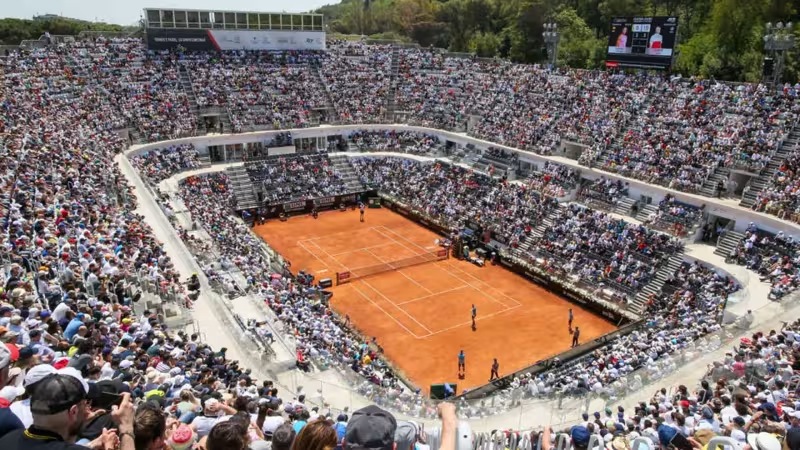
Roland Garros
Altitude: 40 meters above sea level
Climate: generally very hot
Approaching summer, Paris experiences mostly hot days, often nearing 30ºC. This favors a high bounce of the ball and a highly characteristic clay court playing style.
The size of the central court, Philippe Chatrier, is another critical factor: being so extensive allows players to position far back to load their shots with spin and give more weight to the ball.
Moreover, with matches played in best-of-five sets, physical aspects become immensely important. Endurance and the ability to maintain a high level over many hours make the difference.

With the introduction of nighttime matches, new variables emerge. If the temperature drops at night, the game can become slightly slower, especially in later hours. As midnight approaches, humidity rises, and the ball —tending to accumulate more clay— becomes heavier and harder to accelerate.
• Favored players: baseline specialists with plenty of topspin, great defensive skills, and strong physical endurance.
• Disadvantaged players: more offensive profiles relying on serve and flat shots.
A critical detail is that if the weather turns cold, humid, or overcast, conditions may resemble those in Rome. In this context, players whose game relies on topspin may lose effectiveness, while those with flatter, faster strokes can gain an advantage.
In conclusion, players who apply a lot of spin tend to perform better in warm weather, while cold or heavy days tend to work against them. With such a lengthy tournament, there could be very different conditions offering opportunities for all player types, but physical condition is essential in this event.
| Tournament | Speed | Altitude | Playing Style |
|---|---|---|---|
| Monte Carlo | Low | 19m | Defensive |
| Madrid | High | 667m | Offensive/Servers |
| Rome | Low | 25m | Baseline/Tactical |
| Roland Garros | Low | 25m | Complete (Offensive/Defensive) |
This is an automatic translation. You can read the original news, Estas son las diferencias entre los distintos torneos de tierra batida