

Ljubicic, on Federer 2.0: "We knew that you couldn't cut the ball against Nadal"
The former coach of the Swiss tennis player analyzed how his return was after his serious knee injury, and how they changed their style to win more Grand Slams.
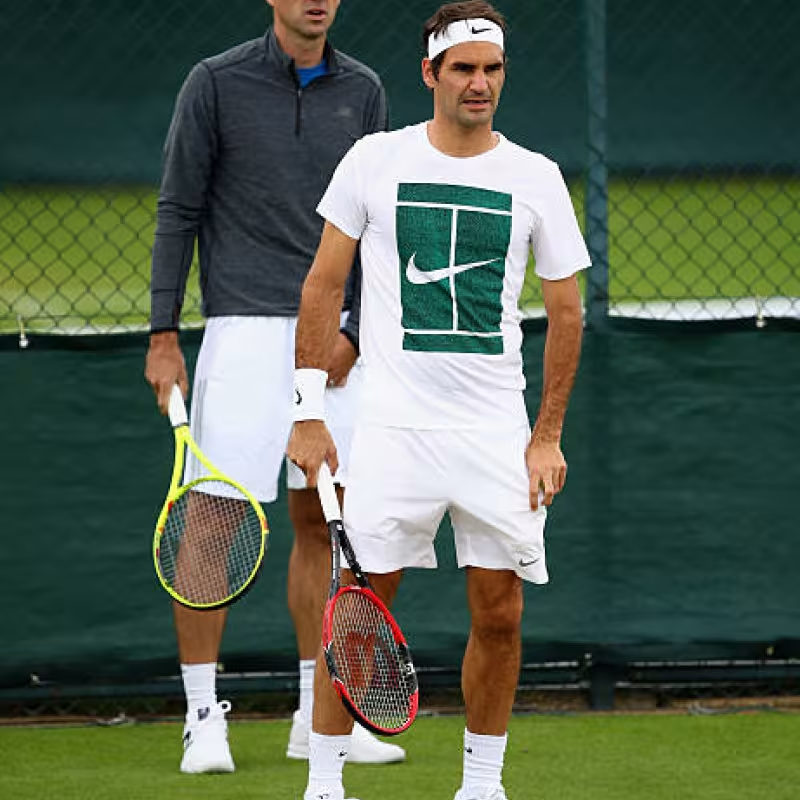
Roger Federer is the ultimate expression of what this sport means. The way the Swiss tennis player plays transcends any era, and one of the architects of this is Ivan Ljubicic. The former coach of Federer, who was present during one of his most glorious periods, has analyzed what his arrival meant to the team in 2016 and how Roger had to reinvent himself to overcome his ordeal with injuries.
That year, Federer's left knee gave out, which many saw as the end of his career. However, the former world number one returned in 2017 with a much more aggressive backhand and fully charged batteries, leading him to achieve the feat at the Australian Open, where he defeated Rafael Nadal in an epic five-set final. A significant part of the credit goes to Ivan Ljubicic, who has spoken on the Off Court podcast about how that period was experienced from within.
"I heard and read many stories about how Ivan changed this and that. It is very difficult to remember, when you are a coach you work on everything at the same time and say so many things that you don't know what will stick. One thing is certain, we all knew that you couldn't slice the ball against Rafa, so for me it was very obvious that he had to hit those backhands if he wanted any chance of beating him. My point was that I wanted him to hit a flat backhand, not a slice or a topspin or a high one," he acknowledges.

Ivan Ljubicic explains how Roger Federer's style changed for 2017
The work paid off, as with little practice, he arrived in Australia like a whirlwind to show the world that the best are able to rise time and time again, no matter how many times they are counted out. His tears after winning that unforgettable final against Nadal said it all. In a few months, Federer crafted his game to suffocate his opponents, stepping onto the court and attacking the ball like he had never done before. The rest is history.
"We worked on it from September 2016 for five months on the return, but you know how it is: you work on something and it sticks in other areas. We worked on the backhand, but it affected other things. Now it is fashionable to say that Ljubicic changed his backhand, and since I had a one-handed backhand, I can only train players with a one-handed backhand. At that time, the perfect storm arrived, and he started to feel very secure with the backhand. 2017 was a great year for his career and for the team. Everything was like a dream," he concluded.
That was a turning point in Federer's career, as between 2017 and 2018 he added two more Grand Slams - Wimbledon and Australia - to reach the coveted 20. Although he finds it hard to boast about it, Ljubicic played a vital role in those results. Federer was the wizard on the court in every match, but a few meters away was a thinking head that changed the gears in search of the perfect machinery, and found it.
This is an automatic translation. You can read the original news, Ljubicic, sobre el Federer 2.0: "Sabíamos que contra Nadal no se podía cortar la bola"