

Joao Fonseca has a problem
Perhaps he didn't know it at that moment, but when Joao won in Buenos Aires, twelve months ago, a problem was born for him.

Joao Fonseca has a problem. Yes, as it sounds. It's not serious because it has a solution, but the Brazilian must quickly understand what lies ahead and solve it to prevent the issue from growing so big that he can't control it and it affects his career.
Do you remember the case of Alexander Zverev? Perhaps now few remember, but it's a quite similar case to Joao's, with some differences. Sascha emerged at just 17 years old, making a fantastic run in Hamburg, reaching the semifinals and defeating four Top 100 players along the way. The buzz generated in Germany was at another level.
Many saw him as the next Boris Becker. A nation eager for a great champion after many years without a Grand Slam title raised the pressure on him to deliver. That's where Zverev's problem began. A burden he still carries 12 years later, now ten times heavier and almost unbearable.
He has often mentioned that the pressure he received (and still receives) from his country to win a Grand Slam affected him and put unwanted pressure on his game. Perhaps those expectations were self-inflicted without much thought, imagining winning big titles when he hadn't even come close. As the years passed and disappointments in Grand Slams accumulated, the snowball grew so large that it started rolling uncontrollably downhill.
That snowball has already begun to form for him.
When he won the Next Gen Finals at the end of 2024 and started 2025 by winning in Canberra and defeating Andrey Rublev in the first round of the Australian Open, many talked about Joao as the new jewel in the tennis world. It was no surprise. A project like his, coupled with very attractive tennis that engaged the viewers, doesn't come around every day.
Brazil, a nation that hasn't seen a number 1 or Grand Slam winner since Guga Kuerten's departure, immediately elevated him to greatness. The global media, ourselves included, were also enthusiastic about his tennis and his persona. We were all delighted to have Alcaraz and Sinner. If we could add Joao to the mix, even better. The hype was through the roof. The expectations, even higher. When he won Buenos Aires exactly twelve months ago, everything was taken to another level.
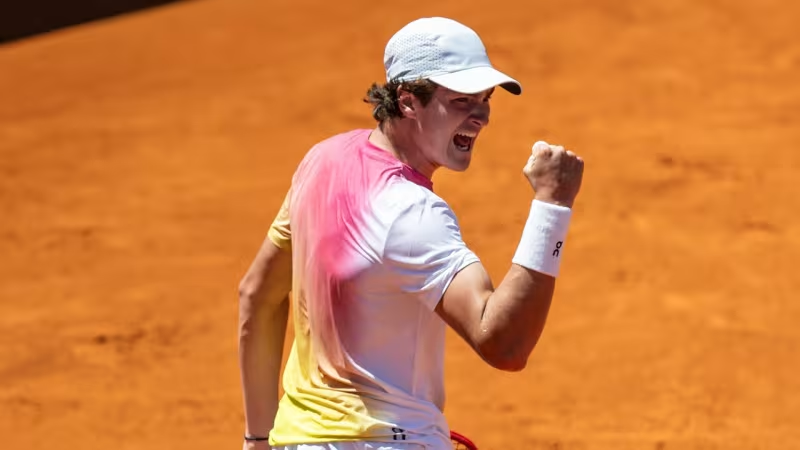
Looking at the past twelve months, the parallelism between the two cases is striking. We have even seen Fonseca cry on the court after a victory, admitting that the pressure from the Brazilian press can overwhelm him at times. Imagine how challenging it must be for such a young guy to open his country's media or turn on the TV and see himself there, being analyzed by journalists or experts, being compared to a tennis legend from his country like Kuerten and touted as a Grand Slam winner.
If you add to that the fact that Joao is still far from being able to compete at a Grand Slam level, it must be tough for him. He might feel like he's letting people down or struggling mentally to meet the high expectations he has set for himself. This manifests in poor tournaments, unexpected losses, inconsistency in his game, and peculiar matches mixed with ones where he can show his best, like in Basel last year.
Regarding comments on social media, it's better for Joao to avoid reading what is said about him on Twitter or Instagram after each defeat.
Joao Fonseca's Problem
Perhaps Fonseca didn't realize it at the time, but winning in Buenos Aires twelve months ago brought him a problem. A blessed or cursed problem, but a problem nonetheless. That's when a snowball started to roll. With every tournament where he doesn't meet expectations, it grows a bit larger. He must find a solution, one way or another, to prevent it from becoming as big as Zverev's.
This is something only he can do. No one else can help him, not even his inner circle. The Brazilian press will keep talking about him. Those who praised him a year ago and may now be more reserved due to his short time in the circuit might eventually turn on him over time, as also happened to Zverev, who hasn't had a good relationship with much of the German press or some tennis legends in his country.
This is another challenge that Joao will have to face. The problem lies in handling external pressure in the best possible way, the one that can harm him the most. He must try to distance himself from what is said about him and pave his own path. His circle can help him stay grounded and focused, but only he can find a solution and prevent it from affecting his game.
His future success hinges on how he overcomes this. There are only two outcomes from here: he emerges as a remarkably strong and well-rounded tennis player, or he ends up sidelined. It's either a winning stroke or the infirmary, as some might say. When someone peaks so young, unfortunately, there are only these two possible paths.
In 2026, Zverev seems to have almost missed the train to that coveted Grand Slam. There's still time for him to achieve it, but the snowball is so large that it's intimidating. Joao has many years ahead to address this problem. Only time will tell if he overcomes it.
This is an automatic translation. You can read the original news, Joao Fonseca tiene un problema