|
3 Jul 2025 | 20.47
|
3 Jul 2025 | 20.47





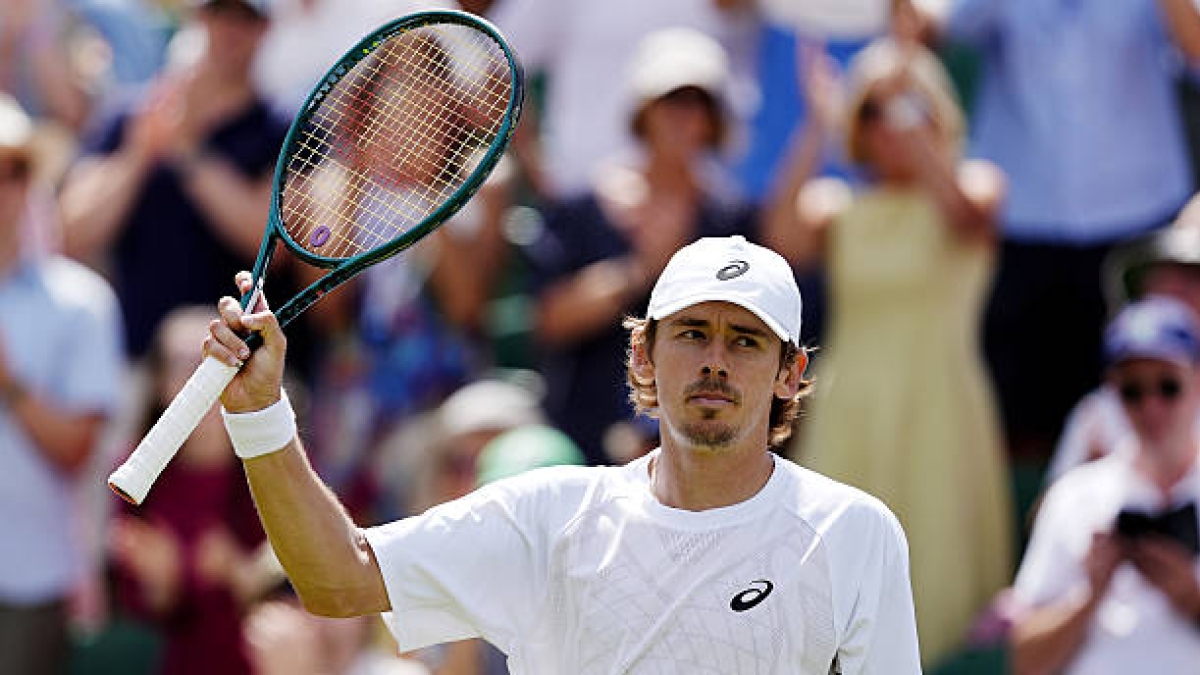


Alex de Miñaur had to rely on patience in the second round of Wimbledon. The Australian secured the victory against Arthur Cazaux after a poor first set (4-6, 6-2, 6-4, 6-0). On other occasions, the world number 11 would not have been able to pull off this type of match, but in London, he is showing a new mentality when approaching games: less pressure and more positivity.
This was the approach he took to come back against the Frenchman. Before facing August Holmfgen, the 'Aussie' attended a press conference. There, he analyzed his victory but also talked about his new mindset, the support of the English crowd, the defeat of his fiancée, Katie Boulter, and took the opportunity to discuss Australian tennis role models and the court conditions.
Feelings after the victory
"Definitely, it was a slow start. It wasn't the type of start I expected, but sometimes that's what happens, and you have to react to what occurs on a given day. It wasn't the way I wanted to play that first set, so I had to mentally readjust for the second set. I'm very glad I did because then I managed to find my game, and, as you said, it improved as the match progressed."
"It was a couple of things. I've never played against him. I've never played with him, so you have to try to understand him a bit. I think I came out a bit nervous, exaggerating a bit, making many mistakes. I told myself to hold back a bit and get into the rallies, gain more confidence as the match progressed. As the rallies extended, I started to feel my shots more. The other big change was my serve. My serve wasn't great in the first set, so I controlled it and decided to take some speed off it and started hitting first serves. A combination of those things benefited me a lot today."
A new way to see his tennis
"In the last couple of days, couple of weeks, my mentality is to take small victories. Not to worry about the overall result but try to focus a bit more on the small wins. I look at this match, and probably the old me would be, like, definitely, I'm not happy with how I started this match. It's not good enough. If I want to achieve certain results here, I need to improve my game, but the way I see it is that I'm happy. I've reset. I found my game. I fought. There were tough moments that I overcame. In the end, I'm here talking to you, ready for another match, giving myself another chance to play good tennis."
Striving to be a role model for young Australian tennis players
"I think, as an Australian growing up, you admire your idols, don't you? You admire the players who came before you. Australia has such a rich history and culture in tennis and in competitors, in athletes. You go from generation to generation. You go to Roche, Newcombe, Laver. Later on, Rafter, Cash, Lleyton. There are so many people to admire, right? That's what makes it easier. Growing up, that's what I saw. That's what I wanted to replicate. That was the norm. That's why I'm so proud to set that standard for the next generation because I want to have a positive impact on the kids growing up and have, you know, the same kind of role models I had when I was young."
He doesn't trust the stats on unforced errors
"I think unforced errors are a very difficult statistic to judge because it all comes down to the individual who decides if it's an unforced error or not, and there are many different factors that can influence a particular shot. It may seem like an easy forehand, but there could be a bit of wind at the last second, a bad bounce, etc., that can affect these types of statistics that are then recorded as unforced errors. Obviously, those figures are quite high."
Regrets Boulter's defeat
"There's no real rule book to base it on, but it's not ideal. It's not nice. I felt for Katie yesterday, and I've been in those positions myself. It's not easy in any way, yeah, forget it. It's something that stays with you. For my part, you know, there's obviously the part of doing everything you can to console her and try to be there for her in the same way she's there for me through the good and the bad things. It definitely has a bit of an impact on yourself, and you have to do everything you can to try to have a mental reset and shift your focus to yourself and realize that you have a match the next day that you need to prepare for. So yeah, there are many different aspects to deal with, which aren't easy, I think I can improve, but that's experience."
Feels at home in Wimbledon
"In the last three or four years, I've felt incredible support, and spending much more time here in the United Kingdom has been very special. I feel like I'm putting down roots here. As I said before, I've been lucky to be at Wimbledon when there's no tournament. I've been able to train here. I've been able to be here with Katie. So I've been able to see the change from a club to a Grand Slam. All those aspects, from spending some time together, being at home, getting to know the place much better, definitely give you a better overall feeling when facing this tournament."
Doesn't see changes in the grass
"I think it's the same as in previous years. I don't know. Three, four, five years, it has always been the same kind of speed. It's slower, but it's something we all know and are accustomed to. Yes, if I had to compare it to Queen's, Queen's is always much faster than Wimbledon. You have a lot more time to adjust. Yes, it's about finding ways to use it to your advantage."
But he also understands his peers' complaints
"Everyone has different feelings, what they prefer, where they feel comfortable, where they don't. Personally, I believe that in the last three or four years, this surface or the length of the grass hasn't really changed, and it has been very similar. Compared to the balls, overall, it's slower. Before, the grass was always fast. It was always fast. The balls flew. That hasn't happened here in Wimbledon for a long time, right? I think that's why there are better rallies, longer ones. You see people starting to slide on the court. Longer rallies are created, and I'm sure the audience enjoys it a lot more," concludes a De Miñaur who is changing his mindset to go further in the Grand Slams.
This news is an automatic translation. You can read the original news, De Miñaur y una nueva mentalidad: "Me centro en conseguir pequeñas victorias"
-
 15 Jun 2026 | 20:00Davidovich reveals how he prepares for the grass court tour
 -
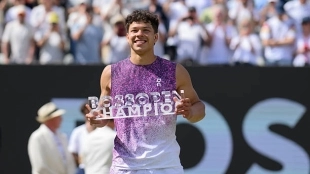 14 Jun 2026 | 17:00Shelton conquers Stuttgart and wakes up in time for Wimbledon
 -
 15 Jun 2026 | 17:00BREAKING: Jodar withdraws from Queen's due to injury
 -
 15 Jun 2026 | 08:00Alcaraz's recovery enters a crucial moment
 -
 15 Jun 2026 | 23:00Daniel Evans' dart at the Queen's tournament after not receiving a wildcard
 -
 14 Jun 2026 | 18:00It is never too late for Majchrzak
 -
 15 Jun 2026 | 00:00ATP Ranking: Djokovic's Presence in the Top 10 in Danger Eight Years Later
 -
 15 Jun 2026 | 13:00Mensik explains what is the hardest thing about playing on grass for him
 -
 15 Jun 2026 | 21:00The serious risk Djokovic faces at Wimbledon
 -
 15 Jun 2026 | 18:00Alcaraz aims for three possible tournaments for his return