

The new Carlos Alcaraz indoors: the improvements that make him more lethal
The player from Murcia has refined some parts of his game to make his tennis lethal even on hard courts indoors. We break down his improvements for you.

Carlos Alcaraz is emerging as the benchmark of the ATP circuit... also on indoor hard courts. It had always been the little Achilles' heel of the Murcian, the place where he felt least comfortable, further away from his tennis patterns. The reasons were varied: the timing of this tour in the calendar, the accumulated tiredness and fatigue before arriving indoors, the colder environments of the arenas, the speed and quickness of some tournaments... all that is behind him: 2026 is unlocking a new version of Carlos Alcaraz that is arriving thanks, indeed, to hard work and repetitions.
Because it’s not just the rest afforded by the four months of injury that have caused Carlitos to show a new face on this stage. There’s no point in having fresher legs if you don’t back it up with a clear game plan, with patterns that make you better on such fast surfaces and an improvement in shots that are essential indoors. After doubts about his serve in the first tournament following his return, in a US Open where we saw him serving far from his usual numbers, the bravest and most aggressive Alcaraz has returned, with an update on his first serve that has always allowed him to dominate his opponents.
Data Supporting Alcaraz 2.0 Indoors: A More Dominant Version than Ever
When we isolate his numbers in Vienna and Paris, one adjective comes to mind: versatility. Before diving into common denominators, the aspects of his tennis that stand out above his average differ between the two tournaments: both are indoors, but the speed of their surfaces is very different. While in Paris, the fastest on the circuit, his strong points are the serve and his conversion ability (that is, the ability to win points when he is attacking), in Vienna, on a rougher and slower surface, his backhand and returning shone, giving him the necessary solidity to tilt exchanges from the baseline in his favor and the ability to dominate through returning.

That said: in both tournaments we saw an aggressive Alcaraz, who imposes his forehand from the center of the court... and who presents serve numbers superior to his average. In Paris, the improvement became even more palpable, with 0.6 percentage points higher, in addition to a 5% higher capacity to close points when moving forward. We're talking about a Carlos more capable of resolving points with his first hits, shielded by a devastating serve... which has appeared, in its improved version, especially in crucial moments.
When we examine the service data, there are a couple of figures that stand out and allow us to understand the Murcian's ability to save break points in abundance. Alcaraz saved 82% of break points faced in Paris (an impressive 18 out of 22), allowing him to maintain his serve in 92% of the service games he played. This represents an impressive improvement from his average: 66% of saved break points and 88% of service games won. It's not the only aspect in which Carlos has improved, as he shows an improvement of about 1% or 2% in other service-related facets.
To understand this evolution, we need to focus on what has become one of the Spaniard's favorite serves: the T serve on the advantage side. This is the area of the court where most break points are contested (every time there’s an advantage), and the player from El Palmar has found refuge in his first serve to save them. Why? He has improved his serve accuracy to become one of the circuit's top sharpshooters... and that particular serve is a prime example of this.
Alcaraz averaged 50 centimeters of distance to the lines in his T serve on the advantage side: his average in Paris and Vienna became 43 cm. Every serve of Carlos to that area was an average of 7 cm closer to the service line, making his serve an almost impossible shot to attack. He also improves his distance to the line by up to 4 centimeters in the open serve on the deuce side, and maintains slightly worse figures in the other two serve types: his average distance to the lines has been 57.6 cm during this indoor tour, almost 4 centimeters improvement over his usual average (61.3 cm).

We have often talked about how accuracy in your serve is one of those silent characteristics that elevates that shot to another level. A great example is Jannik Sinner, who served much more distance than Carlos in terms of distance and precision; Alcaraz promises to narrow that gap with these figures, getting closer to the numbers of the best on the circuit. Not only that: this ability to serve more accurately has allowed him to find his next shot in better situations more often, with a 2% increase in shots well inside the court and a 5% increase in shots from the center area, making his serve + 1 an even more lethal combination during this tour.
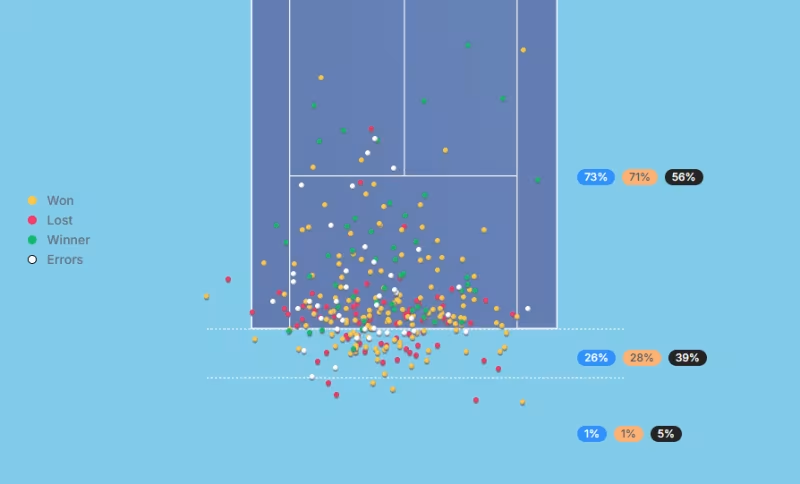

Precision, security, bravery, and total confidence in the work done on a fundamental shot when playing indoors. It’s no coincidence that Carlos has collected titles: his style is more adaptable than ever to what is demanded indoors, he himself shows versatility depending on the speeds, and the improvements in his shots have allowed him to be uncontestable under pressure. A new version that comes hungry, ravenous, and eager to conquer Turin and Bologna: the rest of the circuit should be prepared.
This is an automatic translation. You can read the original news, El nuevo Carlos Alcaraz en indoor: las mejoras que le hacen más letal