

The aspects of the game where Jódar has the most room for improvement
The Spanish player emphasizes how much he has to improve as a tennis player, but in what technical and tactical factors can he do so more?

Rafael Jódar is challenging logic and defying any reasonable predictions surrounding him in his first season as a professional tennis player. In the fight to be in the top-10 and qualify for the ATP Finals 2026, the Madrid player insists at every press conference on how much he needs to improve, but in what areas can he intensify his efforts? We explain it with data from our friends at Tennis Insights.
One of the most alarming things about Rafael Jódar is that he gives the impression of being an incomplete tennis player. There are clearly improvable aspects, and that hasn't prevented the Madrid player from having a spectacular first year as a professional tennis player. Achieving so much in such a short time and with obvious factors needing polish raises a powerful question for all tennis fans. How far can he go if he continues to evolve?
Jódar, with room for improvement in key factors of the game
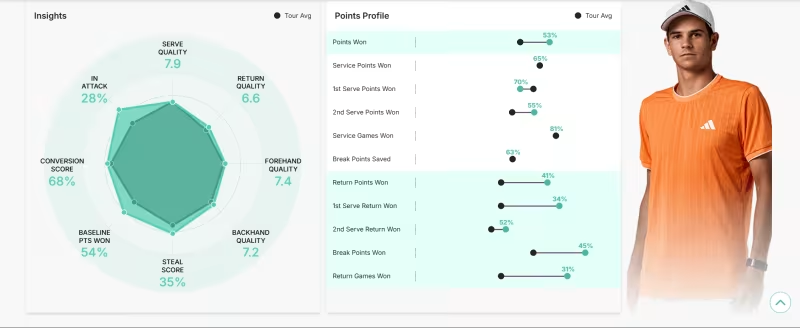
To discern in which shots and situations he has greater room for evolution, nothing is better than consulting the official statistical data. A glance at the most generic figures reveals that a player in Jódar's current ranking does not possess metrics that are particularly superior to the circuit average in key aspects of the game.
In fact, both in the serve and in the forehand, he scores almost identically to the circuit average, which is unusual for a tennis player who has the potential to be top-10 in the short term. Neither the backhand nor the return are especially superior. So, how is Jódar building his ascent to glory?
Several factors come into play here. Some of them can also be explained statistically, such as the offensive mindset and ability to take the ball early and apply pressure on all shots, leveraging his wingspan to play above the baseline and change directions with all his hits. Also, his efficiency when playing aggressively (54% of points won) and a skill superior to what one would expect from a player like him in defensive situations (39% of points won when being dominated).
However, it is the intangibles that best explain Jódar's success. His maturity in managing difficult situations, his ability to elevate his level in crucial moments of matches, and a competitive skill that cannot be trained, but rather comes naturally and is becoming a fundamental part of the solid foundations upon which he continues to build. Evidence of this is his effectiveness in converting break points, for example.
The serve and the forehand, key aspects to work on
Many specialists notice structural details to modify in both shots. Especially with the serve, it wouldn’t be surprising if Rafa had to adjust his serving mechanics to better toss the ball and utilize his height and the power of his levers to be much more effective with this shot.
A player of his caliber must be more dominant on serve, and this shot could significantly elevate his competitive ceiling. Varying spins and speeds should come more naturally to him, as well as winning more free points with his first serves.
Regarding the forehand, it was always the shot that seemed to limit him most before he took the leap to professionalism, but he has shown exponential improvement that explains his strong performance this year. However, he still has a lot of room to improve. The way he imparts topspin on cross-court shots when entering the court should be taken as a reference to understand how far he can go.
He has the ability to be more aggressive with his parallel drive, to reduce errors by applying more weight, depth, and height to his shots when he is not in a dominant position, and ultimately to reduce unforced errors.
Tactical variety, a matter to work on for the final leap
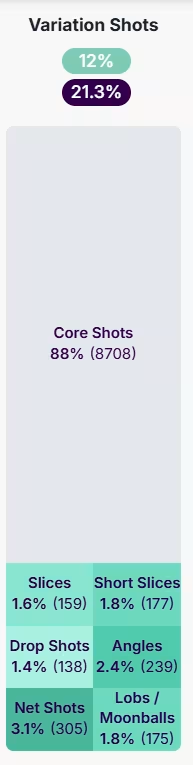
While it is true that Rafa and his team will need to focus more on the basics during the next preseason, there is also an exciting path to explore regarding becoming a more unpredictable player. He is showing the ability to dominate his opponents with his groundstrokes, and when that happens, a range of options to drop shot or approach the net becomes available.
It is likely that opponents will begin to better interpret his playing style, so introducing new tools more frequently will enrich his game. He should also work on the slice backhand, a shot he hardly uses but that can be very useful in certain situations.
In conclusion, it is worth noting that Rafael Jódar conveys an unyielding work ethic and determination to improve, being aware that he has built something impressive in a very short time and that he can still evolve significantly in crucial aspects of the game. If he continues to rack up wins and meet his goals, we could see a top-10 player and/or participant in the ATP Finals 2026 with a much higher competitive ceiling than what has been reached.
This is an automatic translation. You can read the original news, Los aspectos del juego en los que Jódar tiene más margen de mejora