

Federer explains why the one-handed backhand is on the brink of extinction
The Swiss press conference in New York touched on several interesting topics, among which the question about the one-handed backhand and its loss of prominence within the ATP circuit stood out. Are we witnessing the end of this shot?

The US Open 2026 was smart enough yesterday to invite Roger Federer to come to the press room to chat with journalists for a while. There were more than 20 minutes of questions, although one of the best didn't come until the end. What is happening with the one-handed backhand?
Looking at the men's ranking, the answer seems obvious: the one-handed backhand has been showing signs of being close to extinction for a decade. This is a fascinating debate that has been going on for several months in various press conferences, but when the one responding is Roger Federer, everything seems to make a bit more sense. The Swiss did not hesitate to provide his perspective, showing realism and concern at the same time.
“Maybe that's why I'm going to train this afternoon with Musetti, to make sure he is prepared and to give him some wisdom,” Federer joked to lighten the seriousness of the question, referring to the Italian, one of the last great exponents of the one-handed backhand. He then provided the analysis: “When your coach is a one-handed player, you are probably one too. The problem is that now most coaches were two-handed players and, above all, it is much easier to teach that stroke to a child," said the 20-time Grand Slam champion.
Roger Federer explains why the one-handed backhand is disappearing
This highlights one of the big differences compared to previous generations. Federer explains that learning and mastering a one-handed backhand requires patience, something that modern tennis does not always allow. “If you make technical changes, it takes too long and becomes frustrating. Nowadays, everything has to happen immediately,” he reflected. The Swiss himself used one of his children as an example, who is trying to change from a two-handed backhand to a one-handed backhand and is experiencing the difficulty of the process firsthand.
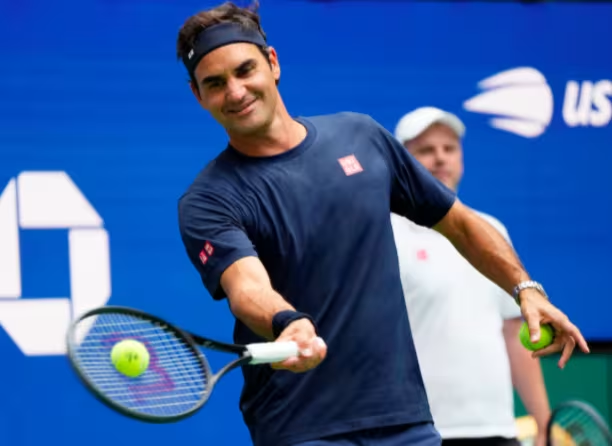
But Federer did not stop at technique; he also pointed out the evolution of equipment, strings, balls, and surfaces, as well as the transformation of training. In the past, much more work was done on the transition to the net and volleys, while today tennis is fundamentally from the baseline. In that scenario, the two-handed backhand provides an evident advantage: the ability to defend better, especially from open positions and while moving.
The revolution led by Nadal and Djokovic is the best example.
What used to be considered a weakness of the two-handed backhand — the difficulty in defending certain angles — has now become one of its great strengths. Federer admitted that there are also concerns about injuries associated with the two-handed backhand, particularly in the left wrist of right-handed players, but believes these will not be enough to change the trend. “The accumulation of all this has resulted in seeing many more players with two hands, although I still hope it won't be the end,” he concluded with a smile, leaving the door open to hope.
This is an automatic translation. You can read the original news, Federer explica por qué el revés a una mano está al borde de la extinción