

Fritz compares himself to Nadal for his knee problems and attitude towards pain
The American acknowledged in Cincinnati that he continues to play with knee pain, drawing parallels between his attitude towards adversity and Nadal's, and criticized the ATP calendar.

Taylor Fritz has been caught in a spiral of tennis and emotional ups and downs for over a year, resulting in knee problems that are affecting his career as they have not completely disappeared yet. During the Media Day of the ATP Masters 1000 Cincinnati 2026, he spoke extensively about it, making references to the very Rafael Nadal.
Injuries are becoming increasingly common on the circuit, but they take on an extra level of danger when they become chronic. Taylor Fritz is passionate about tennis and, although he accepted to take a break this year for a few tournaments, he has encountered continued discomfort upon his return and is determined to continue competing, despite doing so in pain. The Californian believes that the ATP calendar shares some of the responsibility for this.
Taylor Fritz explains his physical problems in Cincinnati and criticizes the ATP calendar
Knee pain, a torment for Fritz
Fritz was asked about Rafa Nadal's philosophy of accepting physical suffering and found similarities with his own situation. The American asserts that as long as there is no risk of worsening his injury, he prefers to compete rather than withdraw. His absence for a few months this season has not resolved a problem that seems to be chronic.
"If you know that you are not going to worsen the situation and that you are not going to damage your career by doing it, you tell yourself: 'Yes, why not?'. So you just try to get through it and do the best you can."
"I hate giving up. It may not necessarily be quitting, because probably the smartest thing when you are injured is to take a break sometimes, but for me, it's hard not to feel like I'm giving up."
"Sometimes at the beginning of the year my knee feels worse. That doesn’t necessarily mean it is getting worse. It just gets more irritable at times. If I can play with it, I try to do so."
"I was told that it can happen and that it is not going to worsen. If I feel like I can keep going, there’s no need for me to withdraw."
His body said enough in Montreal after winning in Washington
Irrefutable evidence that something is wrong with his body is how Fritz admits that he found it impossible to perform in Montreal, with his debut just 48 hours after winning in Washington. This also clearly demonstrates that the current calendar exposes players to more injuries.
"I am much more prepared to play here than when I arrived in Canada. I think it was fine that I wanted to try to play in Montreal, but after the first set of that match, I probably should have shaken his hand and ended it."
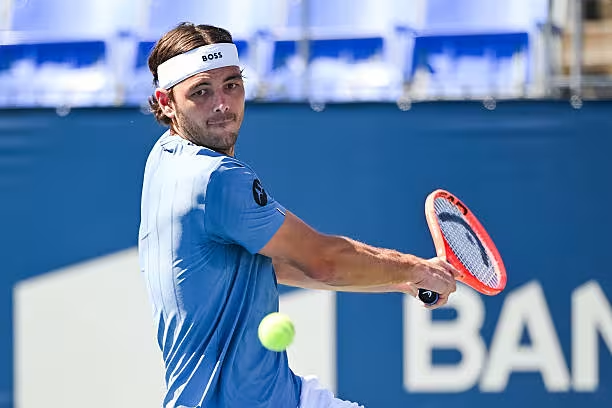
"My body was not well. It was tough to go from Washington and play the next day. I felt really good playing during Washington, but afterward, I felt like I mentally knew that the tournament was over. My body just hit a wall."
Acidic criticism of the ATP calendar from Fritz
The American agrees with Alexander Zverev that the current structure of the calendar makes it difficult for the best players to compete at their highest level in all tournaments leading up to the US Open. He believes it is inevitable that many players will try to pick and choose, resulting in significant absences.
"I don't know if anyone is really prioritizing one over the other. I suppose those who skipped Canada are focused on Cincinnati. It’s very difficult to play a long tournament, go far, and then go straight to the next one and be able to go far again."
"I think it was easier when it was a week on, a week off, and then two weeks. Now it's three weeks in a row without a break. And if you play Washington, it's four weeks. It's a lot of tennis and a quick turnaround if you are playing well."
"But, to be honest, that happens for a large part of the year. If you are doing really well in a tournament, the transition to the next one is very tough. With the week off between Cincinnati and the US Open, I think everyone will be prepared for the Grand Slam."
The absence of Sinner and Alcaraz opens an opportunity
"Maybe once you get to the later stages of the tournament, but it’s not something I'm going to think about until the quarterfinals. As a high seed, you won’t notice the difference of their absence until the quarters or semifinals."
"So until then, it's just another tournament. Obviously, there’s an opportunity, but it’s an opportunity that comes at the end of the tournament. I think the players immediately following in the rankings feel a little more pressure to win a title or seize the opportunity."
"But, as I said before, I don't notice any difference until I’m in the quarterfinals and then the moment comes to play against one of those players and there’s someone who isn’t there."
It seems there is a clear consensus among players that it’s not feasible to continue with this calendar. Many might think that having rest days between matches of the same Masters 1000 is advantageous, but what it does is increase the time players spend in competition mode. More stress, more time with routines, and more physical and mental strain.
Furthermore, the physical demands of modern tennis in terms of power, agility, explosive movements, and speed make it impossible to play so many consecutive tournaments in a short time. Taylor Fritz has already suffered the consequences and will try to cope with it and make the most of this rest time he has had before the ATP Masters 1000 Cincinnati 2026.
This is an automatic translation. You can read the original news, Fritz se compara con Nadal por sus problemas de rodilla y actitud ante el dolor