

The major pending issue for Joao Fonseca
The defeat against Shelton once again highlights that Fonseca urgently needs to improve two aspects of his game, and one of them is very important.

Joao Fonseca's participation in the ATP Montreal tournament has ended, and it concluded with a defeat in the round of 16 against Ben Shelton that has stung a little. There was quite a bit of hope regarding the opportunity the Brazilian had to make a big impact in an M1000 category tournament. Joao has not yet achieved consistency in his results, and upon analyzing his tennis, there are areas that urgently need improvement.
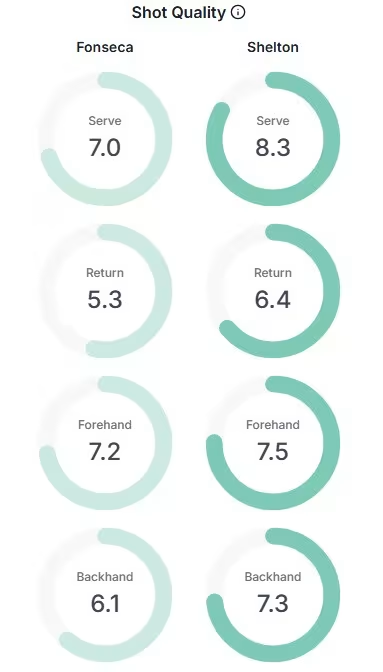
Looking at the data provided by Insights, from TennisViz, we see that in the match against Shelton, Joao recorded poor numbers in two specific strokes: his return and his backhand. It’s not groundbreaking to say that these are the two areas of Fonseca's game with the most room for improvement, but it is striking that as months go by, this continues to be something he struggles with and he rarely sees any green shoots in almost any tournament.
After the tremendous Roland Garros he had, winning against Djokovic and Ruud and reaching the quarterfinals in a Grand Slam for the first time, we thought that perhaps this was what Fonseca needed to make a definitive leap in his career. But the truth is that it seemed more like a mirage. Four wins and three losses in seven matches, with another loss against a Top 10, making it the seventh in nine matches. There is something missing when facing the Top players.
The return, what worries the most in Fonseca's tennis
In today's tennis, it's essential to control two key aspects: the serve and the return. In addition to having other strokes in the package, if you do not master both elements, you'll always have an incomplete player. One who might have a good tournament, month, quarter, or tour, but in the long run, will end up being inconsistent and irregular, something that precisely affects the Brazilian.
Regarding the serve, Fonseca has a notable serve, and although there is room for growth, his return falters significantly, and that is a handicap when facing the Top players. Against Shelton, Joao looked significantly inferior in the return game, managing to win very few points (16 out of 63). With those numbers, it is typical to face a disadvantage against opponents. Not having a strong return may allow him to win against a Top 50 player, but when it comes to facing a highly-ranked player, it shows.
His backhand, another handicap to add
A similar situation occurs with the backhand. He has a forehand that is world-class and has improved a lot, being his great weapon on the court, but his backhand is weak, and during play, opponents keep targeting him there because they know he is more vulnerable in that area. They insist so much because they know he will end up yielding a short ball or making an error.
His inconsistency on the backhand side leads to another issue: Fonseca is a naturally impatient player. The ball burns on his racket and he wants to finish the point as quickly as possible. Sometimes, he loses patience when they persistently attack him there, taking risks from difficult areas with cross-court shots, or he ends up overextending himself to go for a winner that doesn't always land in the target.
Hence, we see Joao accumulating more errors than he should in matches against the Top players. When facing one of the best in the world and the rallies are longer or require seeking new weapons, the mistakes surge to alarming numbers. Against Shelton, he finished with 32 unforced errors, 14 from forehand and 9 from backhand. A lot. If we add to that he only made 15 winners compared to Shelton's 26, it’s even worse.
Looking at the data from @tennis_insights, we see two major areas where the alarm goes off: the return and the backhand.
This is not new. Joao has been showing weaknesses in these two facets for a year now, but while his forehand and serve have made strides, so has his… pic.twitter.com/ZsCffmg17t— José Morón (@jmgmoron) August 10, 2026
Fonseca urgently needs to work on these aspects
With all due respect, his case reminds a bit of what happened to Tsitsipas in his beginnings. From a very young age, the Greek showed great potential, and we all saw in him a future Grand Slam winner, even knowing that his backhand and return were his two major weaknesses. His great weapons, with a powerful serve and a top forehand, somewhat disguised his weaknesses.
Over time, Stefanos did not improve either of these two aspects. In fact, we would say he even got worse. And that led to the fall of the rest of his tennis. Joao, at only 19 years old, has many years ahead to work on this and add improvements to his game to become a better player.
He and his team need to carefully measure the steps they want to take from now on, because if not, he runs the risk of stagnating or failing to meet the generated expectations, which would work against him. It is crucial that they work correctly to correct this, and, if deemed necessary, add new voices to the team to help achieve these goals.
Although he has competed well when facing several Top players, such as Sinner or Zverev, it doesn't seem that Joao is satisfied with that alone, as he will want to defeat them and add victories. However, to do this, he will need to improve in these areas, or the task will be too challenging even for a talented player like Joao. Time will tell if he can do it or not.
This is an automatic translation. You can read the original news, La gran asignatura pendiente de Joao Fonseca