

Draper and the fear surrounding his physique: "Something has to change or his career could be short"
There are many doubts and fears in the United Kingdom regarding Jack Draper's physical issues and his ability to maintain consistency. An expert in sports medicine makes explosive statements.

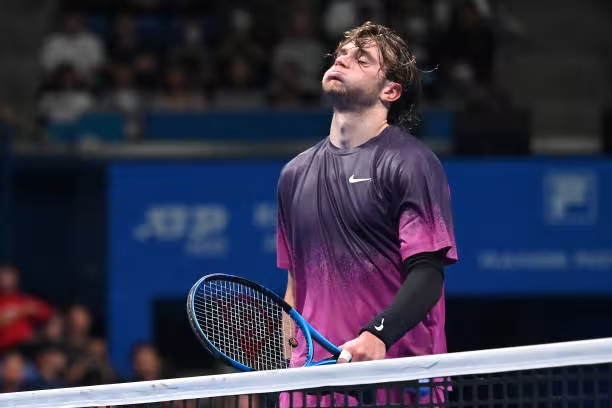
Jack Draper faces a great deal of media attention as he returns to the courts. Injuries have influenced his entire career, limiting his best moments and raising serious doubts about whether his body can withstand the demands of professional tennis. An expert in sports medicine and injury prevention raises alarm with his outlook on the matter.
At 24, Jack Draper has already dealt with an uncommon amount of physical issues for a player his age. Abdominal injuries, shoulder discomfort, difficulties in his left arm, and various leg problems have accompanied a career that, when allowed to compete consistently, has confirmed that he possesses enough level to aim for the most ambitious goals.
However, every new progress seems to be followed by a subsequent setback, creating a sense of fragility that is starting to worry even specialists outside his circle. In an article for Tennis365, the expert Stephen Smith addresses this issue and brings up many points for reflection.
Jack Draper's Injuries: The Issue Goes Beyond a Simple Setback
One of the most interesting aspects of the reflections by Stephen Smith is that he does not focus on the current injury but on the pattern that has repeated over the past years. According to the specialist, the debate should not revolve solely around when Draper will return to competition or if he will be ready for Wimbledon. The truly important question is whether he will be able to stay healthy for long periods once he is back on the courts.
"In general, with recurring problems related to the knee tendon, the challenge is not just about returning to the court once," explains Smith. The expert points out that these types of injuries often have a cumulative origin and rarely appear in isolation. "Tendon problems tend to be repetitive strain injuries.
They are usually an accumulation of load, pain, inflammation, and discomfort." It is a description that fits perfectly with the situation of a player under constant pressure, forced to combine intense training, travel, surface changes, and competition almost year-round.
Smith's concern lies in the fact that the recovery from a specific injury does not necessarily ensure the resolution of the problem. A player may return to compete, play in some tournaments, and even achieve good results. However, that does not mean they have regained the ability to endure the physical demands of modern tennis. This is where the big question mark around Draper arises.
Can Jack Draper Handle the Demands of Elite Tennis?
The specialist's most decisive statement revolves around a question that perhaps many fans had never explicitly considered before. "The real question here is whether Jack Draper can tolerate the intensity of elite tennis."
Smith elaborates on this idea by explaining that the challenge is not limited to playing important matches. What is truly challenging is dealing with everything surrounding those matches. "Consecutive days of training, repeated matches, travel, surface changes, and recovery demands over time." In other words, the concern is not whether Draper can perform well for a week but if he can do so for ten months straight without his body presenting issues.
That is why he believes that his team's work should be geared towards a much broader goal than just a specific recovery. "They probably focus on restoring repeatability." The term is particularly interesting as it succinctly summarizes the challenge that lies ahead for the Briton. It is not just about being ready for the next tournament but about being able to repeat efforts, workloads, and weeks of competition without constant setbacks.
"They won't just be thinking: 'Can we have him ready for this tournament?'" According to Smith, the questions they should be asking are much more demanding. "They will be wondering how to restore that repeatability. Can he train hard for consecutive days? Can he maintain movement quality under fatigue? Can he recover properly between training and matches?" These seemingly simple questions actually form the basis on which any successful career in professional sports is built.
The Danger of Compensatory Injuries and Accumulated Strain
Another aspect that particularly concerns the expert is related to the indirect consequences of injuries. Often, people talk about a specific knee, shoulder, or wrist issue, but the body functions as an interconnected system where a disturbance in one area can lead to problems in apparently unrelated zones.
"If you have a bone bruise that is localized within the joint, it can also alter joint mechanics and movement mechanics," explains Smith. When this happens, the athlete unconsciously tries to protect the damaged area by modifying certain biomechanical patterns. The issue is that these changes can shift physical stress to other parts of the body.

"You try to reduce pressure from one area by moving slightly differently, and end up putting pressure on another." From there, new discomforts may appear, leading to a chain of problems that are hard to break. "You can develop compensatory issues or secondary injuries that stem from a primary injury. This is not uncommon."
Smith believes that the current context of professional tennis makes it even harder to escape this cycle. "The schedule, the demands imposed, all these things... it's kind of a crescendo. Everything accumulates. And it's hard to break free from that." This reflection aligns with a debate that is becoming more prevalent on the circuit and affecting players of all ages and levels.
The Serious Warning about Draper's Future
The most striking part of the interview comes when the specialist analyzes Draper's accumulated medical history and concludes that perhaps it is time to reconsider some fundamental issues.
"I think it's a sign that there might be something missing from a management perspective," says Smith. The expert does not directly point to any responsible person but suggests it would be beneficial to review various aspects related to physical preparation, training planning, or managing competitive workloads.
"Perhaps he needs more or less of something. More strength and conditioning work. Adjustments in how competitions are managed. Reviewing how training loads are controlled." He even proposes the possibility of introducing technical or biomechanical adjustments if necessary to protect specific body areas.
The conclusion he draws is probably the most decisive phrase in the entire interview. "I think having the injury history he has at the age he is obliges to be aware that something has to change now or he will end up with a shorter career than he should." It is not an inevitable prediction but a serious warning, especially coming from someone accustomed to working with athletes subject to significant physical demands.
Juan Martín del Potro, the Example No One Wants to Repeat with Draper
To illustrate the risk he observes in Draper's case, Smith referred to a name that evokes a mixture of admiration and sadness among tennis fans. "Let's think of someone like Juan Martín del Potro." The comparison is not to draw exact parallels between the two players but to recall how a career meant to make history ended up being conditioned by insurmountable physical issues.
"We had an incredible talent, probably with one of the most powerful forehands we have ever seen." However, that same strength eventually turned into a constant source of suffering. "His greatest strength ended up becoming one of his biggest problems. All those wrist injuries and surgeries arrived because the situation was not rectified in time."
The reflection is particularly relevant in Draper's case. His powerful physique, athletic ability, and aggressive style of play are precisely some of his greatest attributes. Yet, sports history is full of examples showing that mismanaged strength can become a vulnerability.
Wimbledon will serve to assess where Jack Draper currently stands. However, after hearing Smith's words, the most important question no longer seems to be how many matches he will win this summer. The lingering question over his career is much more crucial: whether he will manage to find the necessary physical continuity to unleash all the talent he possesses. Because his level is unquestionable. The growing uncertainty is about how long he can sustain it on the court.
This is an automatic translation. You can read the original news, Draper y el temor en torno a su físico: "Algo tiene que cambiar o su carrera podría ser corta"