

Zverev: "Winning an Olympic gold seems more special to me than being a Grand Slam champion"
The German talks about the nerves experienced at Roland Garros, analyzes his expectations on the grass court season, and compares the feeling of winning Olympic gold to that of being a Grand Slam champion.

Alexander Zverev is now part of the exclusive group of Grand Slam champions. The German conquered Roland Garros 2026 after a decade among the elite of global tennis and put an end to one of the major unfinished parts of his career. Reflect on everything he has experienced and what ambitions he holds for the future now that his career has entered a new stage.
Days after lifting the trophy in Paris, Alexander Zverev gave an extensive interview to Sky Germany in which he looked back on everything that happened during the two weeks in Paris. The German talked about the luck he missed in other Grand Slams, confessed the enormous pressure he felt after the eliminations of Jannik Sinner and Novak Djokovic, analyzed his historical problems on grass, and reflected on how this title can change the rest of his career.
Alexander Zverev opens up about the pressure and impact of winning Roland Garros 2026
Zverev explains why he deserved to win a Grand Slam
"I believe we earned this victory. We did almost everything, or many things, to achieve this success. Of course, there were comments from many people like, 'Okay, Sinner lost, Alcaraz didn't even play.' But how much bad luck have I had in Grand Slams in recent years? I think it's good to have a bit of luck once in a career, and I am more than happy to accept it."
"I've simply done enough in the last 10 or 15 years to win a Grand Slam. Of course, you can never be 100% sure of winning it. Especially because we've had so many incredible players. Before there were Novak, Rafa, and Roger, and now there are Alcaraz and Sinner. There's never a guarantee of winning. But of course, I am happy. I am happy to have finally won this title."
"I've received many messages from other players and my colleagues on the circuit. I think what means the most to me is that they are happy for me. That is something very special."
Zverev admits that Sinner's elimination changed his mental state
"No. I faked it to the max. I convinced myself. I lied to myself for my own good. Now I can be honest about it. When Sinner lost, I didn't sleep at all that night. Fortunately, the next day I played in the afternoon against Quentin Halys, so I could sleep for a good part of the day. But then something else happened: the match before mine was Djokovic's defeat."
"The worst match I played at Roland Garros was definitely against Quentin Halys. I was tense, didn't feel comfortable, didn't play well, and didn't serve well. It was the only match of the tournament where I didn't serve well. After winning it, I thought, 'Phew, I got through that match. Now I can be myself again. Now I can play tennis again.'"
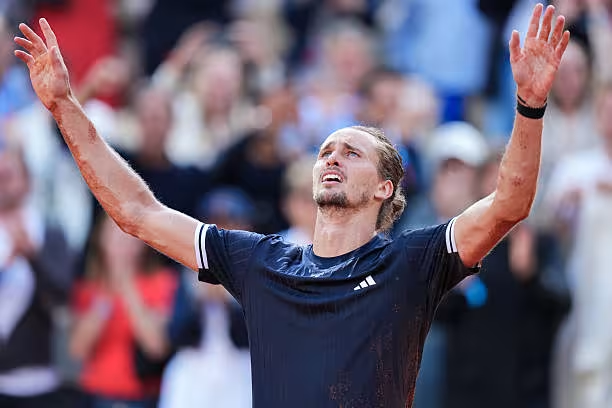
"Honestly, I think it was the most stressful week of my life. I knew suddenly I was the big favorite in this tournament, something that had never happened to me in a Grand Slam. I knew that if I played well, as I have shown all year, and simply played my usual tennis, I could win this tournament, and I had to win it."
"I think I handled that situation incredibly well throughout the tournament, until the final. In the final, I was very nervous, very tense. But even there, in the decisive moments, I played my best tennis. I think I played the best set of the match in the fifth set."
How he convinced himself he could win Roland Garros
"I had to do it. What else could I do? If I sit in a press conference and say, 'I'm nervous, I'm scared,' that doesn't help me, it doesn't help anyone, and maybe it helps my rivals. But if I repeat something to myself a thousand times, there comes a point when you start to believe it. It's a psychological fact. I also ended up believing it from the quarterfinals and the semifinals."
Zverev explains the reason for his cramps in the final
"I wasn't tired at all. I could have played another five sets. Suddenly, I got cramps, and those cramps had nothing to do with the physical aspect. If they had been physical cramps, I would have been tired at the end of the match. I kept running despite the cramps. Nothing really changed. I was just standing there waiting for the serve and the cramps started."
"As I said, it was mental tension. I was incredibly nervous and incredibly tense, which is also human. I'm playing a Grand Slam final as the big favorite and I had never won a Grand Slam before. If I were in that situation now, I think I would be more relaxed and could enjoy it more. But the stress level was incredibly high for me."
Will the title at Roland Garros change Zverev's career?
"I hope so. Of course. I don't know. I'll have to play another tournament first and then I can say how I feel. We're sitting here on Wednesday and everything happened just two and a half days ago. I feel like I haven't slept in two nights because I've been celebrating. I can still be that honest. Afterwards, I've had constant commitments."
"First, I need to calm down, get back to tennis training, and then we'll see. But I think mentally, it will be different. Even if I play a Grand Slam final against Sinner or Alcaraz and things don't go well, I know I have already won one. And no one can take that away from me. My career is not over yet. I hope to play another ten years and then we can talk about it. I want to keep playing tennis, keep competing, and winning big tournaments. And I hope this is not the last Grand Slam of my career."
Alexander Zverev analyzes why he doesn't perform well on grass
"There is a misconception about grass court tennis. People think it's about playing aggressively, but that's not the decisive factor. The key to playing well on grass is the ability to move agilely on the surface. And for me, standing at two meters and weighing 95 kilograms, that's difficult."
"I played incredibly well on grass in 2024. I said then that I felt better than ever. And what happened? I slipped and fractured a knee bone. That's the kind of thing that can only happen on grass. I can play perfectly on fast surfaces. I won Paris-Bercy two years ago. That was probably the fastest hard court in the last ten years."
"I won Cincinnati, which is one of the fastest hard courts in the world. I won the Olympics, and that court was also extremely fast. The speed of the surface benefits me. The problem is the movement. That's my only issue and I have to learn to deal with it."
Zverev values Olympic gold over being a Grand Slam champion
"No. Not for me. The Olympic Games are the hardest title to win. They are held once every four years. We have very few Olympic champions and many great players who never managed to win an Olympic gold. You don't win just for yourself. The whole country supports you. You have an entire nation behind you. The Olympics are simply something much more special."
The conquest of Roland Garros 2026 has not only provided Alexander Zverev with the most important title of his career, but also an emotional release he had been pursuing for years. After countless attempts, lost finals, and moments of frustration, the German has shown that even one of the most established players on the circuit can live with doubts, fears, and mental blocks. The difference is that this time he managed to overcome them when it mattered most, an experience that could mark the beginning of a new stage in his career.
This is an automatic translation. You can read the original news, Zverev: "Ganar un oro olímpico me parece más especial que ser campeón de Grand Slam"