

Wawrinka: "The one-handed backhand will never die"
The Swiss reflected on his career, reaffirmed his great goals in this final season, and made headlines regarding the evolution of tennis.

There are farewells that sound like nostalgia, and others that still smell of competition. The farewell of Stan Wawrinka clearly belongs to the second group. At 39 years old, the Swiss faces his final season as a professional with a very clear idea: to enjoy, yes, but without giving up on demanding the best from himself. In a conversation with TennisChannel, he discussed various issues concerning the present and future of tennis and his career.
Over more than two decades in the elite, Stan Wawrinka has built an atypical career, marked by patience, constant evolution, and a resilient mentality. Far from the early spotlight, his development was progressive until he established himself as one of the most dangerous players on the big stages. His legacy is measured not only in titles but also in the ability to reinvent himself and compete head-to-head with some of the greatest tennis legends.
Always a pleasure to have Stan Wawrinka at our desk 🫶
— Tennis Channel (@TennisChannel) April 10, 2026
The three-time major champ reflects on his career and final season 🥲#RolexMonteCarloMasters pic.twitter.com/3z4a6Y9Ytd
This is What Wawrinka Said About the End of His Career and the Future of Tennis
Competing until the Last Day
"I try to find a way to enjoy and keep pushing myself," he explained, making it clear that his mentality has not changed. Although he admits that he is not winning as many matches as before, he maintains that competitive instinct that took him to the top.
This is not a symbolic farewell tour, but a real final challenge. "I'm not just playing to say goodbye," he stated firmly, emphasizing that his goal is still to win matches and stay competitive on the circuit.
A Career Built on Patience
Wawrinka's path to the elite was not immediate. Unlike other early talents, the Swiss was built slowly, relying on an unwavering work ethic.
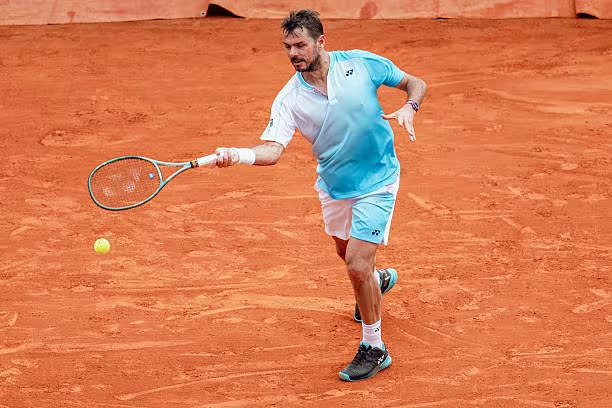
"All confidence comes from daily work," he stated, summarizing a philosophy that defined his career. This approach allowed him to achieve extraordinary milestones: three Grand Slam titles and victories in finals against world number ones.
Furthermore, he always aimed for the long term. "When I was young, I sacrificed tournaments to improve," he recalled, convinced that the real goal was to reach his potential, not immediate results.
Defeating the Best, Without Fear
One of the most distinctive features of his career is having defeated world number ones in Grand Slam finals. For many, it would be extra pressure; for him, an opportunity.
"When you play against the number one, you have less pressure," he explained. This mindset allowed him to compete fearlessly against legends of the sport, trusting his level when the crucial moment arrived. Wawrinka did not need to be the favorite to perform. Feeling prepared was enough, and that preparation always came from unseen work.
Evolving or Disappearing
Few players have experienced as many changes in modern tennis as Wawrinka. From equipment to playing style, everything has evolved, and he has had to constantly adapt.
"The game has changed a lot, especially because of the balls," he pointed out, highlighting how today's tennis demands more physicality and less room for variety. Still, he appreciates having competed against different generations. Regarding one of his trademarks, the one-handed backhand, he is clear: "There will always be players with that style," he affirmed, mentioning Lorenzo Musetti as one of his successors.

Between Idols and New Stars
Like many of his generation, Wawrinka grew up admiring Pete Sampras. In fact, one of the most special moments of his career was receiving his first Grand Slam trophy from the American.
Now, however, he looks at the future of tennis with curiosity. He would have loved to face Carlos Alcaraz at Roland Garros, although if he had to choose a dream match, he would pick Sampras at Wimbledon. This contrast between past and present encapsulates his trajectory: a bridge between eras.
A Farewell Without Concessions
Despite being in his final year, Wawrinka does not want empty tributes. His schedule includes tournaments like Barcelona, Rome, or Geneva, with a focus on Roland Garros, where he hopes to end his career competing at the highest level.
"It would be a dream to finish in the top 100," he acknowledged, never losing sight of the demand that has always defined him. Beyond the results, there is something he values especially: the support of the fans. "The fans have been incredible," he said.
And perhaps therein lies the key to this farewell: it is not a sad goodbye but a recognition of a career built with effort, character, and unforgettable moments. Stan Wawrinka still has much to offer to tennis, enjoying this sport and making all its enthusiasts enjoy it as well.
This is an automatic translation. You can read the original news, Wawrinka: "El revés a una mano nunca morirá"