

Ostapenko: "In tennis, the mind is 75% of everything"
The Latvian player spoke about her volcanic and controversial personality, as well as how difficult it is to stay in the elite in today's women's tennis.

Jelena Ostapenko remains one of the most unpredictable and charismatic figures on the circuit, but also a player who has had to learn to live with the weight of success that came too early. The Latvian, Roland Garros champion in 2017, now reflects from a much more mature perspective on her career, her inconsistency, and the challenge of returning to the elite.
In a recent interview with the Australian Open podcast, Jelena Ostapenko addressed aspects such as her personal growth, the importance of the mental factor, and her goal of regaining a consistency that will allow her to return to the top 10. Particularly intriguing are her confessions about her controversial on-court personality.
Jelena Ostapenko's Understanding of Tennis
The Impact of an Early Grand Slam
One of the most revealing points of the interview was her reflection on that Roland Garros victory at just 20 years old. "It was a long time ago, a great achievement, but I want to live in the present," stated Ostapenko, making it clear that she doesn't want to dwell in the past.
Nevertheless, she admits that success came too soon. "If I had won a Grand Slam when I was a bit older, I would have handled it better," confessed the Latvian in a candid self-assessment.
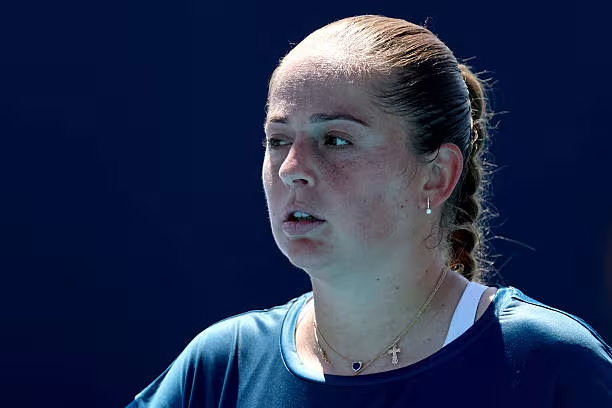
The impact was particularly strong due to her background. "I come from a small country, and all the attention when you come back home is huge," she explained, indicating how that context influenced her development.
The Challenge of Consistency and the Weight of the Mind
Ostapenko is clear about her main challenge for this stage of her career. "I want to be more consistent, especially in the big tournaments," she stated, emphasizing the primary goal of her season.
To achieve this, she has focused on the mental aspect. "Tennis is 70 to 75% mental, everything is in the head," explained the Latvian, underscoring the importance of this component.
This reflection stems from her own experience. "You can play incredibly in training and then not win matches," she added, describing a common reality on the circuit.
Emotion, Authenticity, and Personality on Court
One of Ostapenko's most distinctive traits is her expressiveness on the court, something she is not willing to change. "It comes naturally to me, I am like that, and I don't try to be someone people want me to be," she asserted firmly.
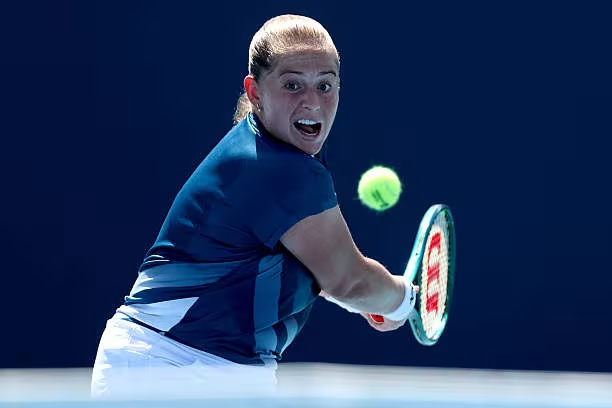
However, she acknowledges that it's an aspect she has had to work on. "Sometimes it can be too much, but if I keep everything inside, I explode," she confessed, explaining her relationship with emotions.
For the Latvian, that authenticity is part of her identity as a player. "People who understand me like it, because I am myself," she added, defending her style.
Looking to the Future: Returning to the Top 10
At 28 years old, Ostapenko faces a new phase with clear goals and a more settled mindset. "I want to return to the Top 10 and be more consistent in the big tournaments," affirmed the Latvian. With greater experience and a more comprehensive view of the circuit, she feels she is better equipped to take on that challenge. "Now I am more mature, and I believe I can do better," she explained.
Far from the explosive emergence of her beginnings, Jelena Ostapenko now aims to build a stronger version of herself. A player who no longer relies solely on talent but understands that true progress lies in mental and competitive stability. All this without giving up her genuine playing style and personality on the court.
This is an automatic translation. You can read the original news, Ostapenko: "En el tenis, la mente es un 75% de todo"