

Pegula gives the keys to her consistency and reveals an unusual obsession with strings
The American claims at Indian Wells 2026 that she pays attention to every detail in her rackets and takes pride in the consistency that characterizes her.

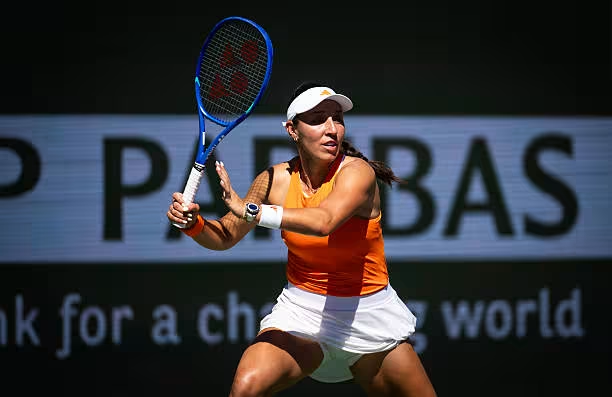
Eternal honor to players like Jessica Pegula. The North American continues to amaze with an uncommon naturalness to remain among the best and achieve good results consistently and regularly throughout the season, despite having fewer weapons than other players. She reflected on this at Indian Wells 2026 after reaching the quarterfinals and commented on her fixation with the string tension.
Jessica Pegula continues to confirm her consistency on the WTA circuit with another solid week at Indian Wells 2026. The American managed to advance to the quarterfinals after defeating Belinda Bencic, a rival who had historically posed many problems for her. After the match, Pegula analyzed the keys to her victory, spoke about her evolution as a player, and reflected on the challenge of adapting to the unique conditions of the Californian tournament.
This is what Jessica Pegula said at Indian Wells 2026 about her consistency and the details of her string tension
Overcoming an uncomfortable opponent
The victory had a special meaning for the North American, who had previously had a very negative record against the Swiss player. Pegula acknowledged that the result has added value precisely due to their previous history. "I'm very happy with today's match," declared the current world number 5 after the encounter. "Being able to turn around my pretty bad record against Belinda always gives me a great feeling," she added.
For the American, defeating a rival who has historically been challenging for her is a sign of progress in her career. "When you manage to overcome that obstacle, it always feels very good," said the player. "I'm glad I was able to accept that challenge and find a way to solve it," she explained.
The unique conditions of Indian Wells
One of the recurring topics of the tournament is the difficulty posed by the playing conditions in Indian Wells, something that Pegula also highlighted after her victory. The American explained that even within the venue itself, there are significant differences between the courts. "It's really tricky," Pegula admitted. "The center court is a bit slower, Stadium 2 seems faster, and some side courts also feel different," she pointed out.
Additionally, the California climate introduces additional variables that complicate ball control. "The air here is very dry and very thin, and sometimes it's very hot, but then it can also cool down and the wind picks up," explained the American. "It's difficult to control the ball when the air is so dry, and at the same time, the court feels slow," she added.
Despite these difficulties, Pegula believes that the key is to simplify the mental approach during the match. "We all struggle with these conditions," she said. "You just try to adapt and play your tennis without thinking too much about it," she commented with motivation to continue progressing in the Californian event.
Constant evolution despite experience
Jessica also talked about her evolution as a player at a stage in her career where she combines experience with a constant desire to improve. The American explained that her physical problems in the early years of her career have influenced her current perception of time on the circuit. "I had many injuries at the beginning of my twenties," Pegula recalled. "Between 20 and 24 years old, I was barely on the circuit because I was either having surgery or recovering," she explained.
That circumstance has made her feel that she still has room to continue evolving as a player. "Maybe that's why I don't feel so old," she confessed with laughter. But beyond age, Pegula considers that one of her greatest strengths is her constant willingness to learn. "I'm always open to trying new things," she stated. "I think one of my greatest strengths as an athlete is that I can change something and implement it quite quickly," she explained.
Tactical adjustments to defeat Bencic
She also acknowledged that her development as a player was key to changing the script in her match with Bencic. "I think I'm a much better player now," affirmed the American. At the same time, she made some tactical adjustments that made the difference against the Swiss player, who has always been challenging for her.
"I've improved a lot with my serve, and that helps me not feel so much pressure when she returns," Pegula explained. Although she preferred not to reveal all the strategic details, she admitted that there were significant changes in her approach. "There were certain game patterns that worked better today and that perhaps I hadn't thought of using in the past," she pointed out.

The obsession with equipment and string tension
Another interesting aspect of the press conference was the importance that Pegula gives to equipment, especially string tension. The American admitted that she is very sensitive to those small changes. "I'm quite demanding with string tension," Pegula acknowledged. "Now I usually carry three or four different tensions because I can feel a big difference with the racquet," she explained.
According to the player, her playing style based on timing and coordination makes those details particularly influential on her performance. "My game depends a lot on the ball sensations," stated a woman who is making strides towards competing for bigger titles. "If something doesn't feel right, I notice it immediately and change it," she added decisively.
The key to her impressive consistency
There was room to reflect on one of the most characteristic traits of her career: her extraordinary regularity in the major tournaments. The American has strung together multiple weeks reaching the final rounds in the most important events on the calendar. "I take great pride in being so consistent," Pegula stated.
"Maybe before, I thought more about winning tournaments, but it's also very challenging to maintain that level week after week," she explained. For the American, the key is to maintain a mental balance that allows her to avoid major ups and downs. "I don't think I have too many peaks or too many lows," she said. "When something isn't going well, I try to react quickly and get back to working on what I need to improve," concluded Jessica Pegula who will face Elena Rybakina in the quarterfinals of Indian Wells 2026.
This is an automatic translation. You can read the original news, Pegula da las claves de su regularidad y desvela una curiosa obsesión con el cordaje